
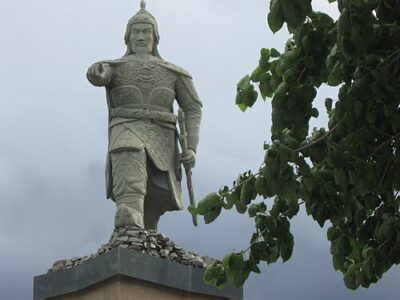
Trần Hưng Đạo
Trần Hưng Đạo was a Vietnamese prince, military general of Trần dynasty. Born 1228, in Thái Bình. Died October 3, 1300, in Hải Dương. Known for Hịch tướng sĩ.
Facts
18 facts · 2 confirmed by two sources · 0 cited · 16 from one source
Where this comes from
Papalocal keeps its own record. It started from these sources; what each one said is kept here as it was copied, so a change on their side never changes this page by itself. Tap one to read its version.
What Wikidata says · copied November 16, 2026 · revision 2490689385
- Described as
- Vietnamese prince, military general of Trần dynasty
- Other names
- Tran Quoc Tuan, Prince Hung Dao, Tran Hung Dao
- Born
- 1228
- Died
- October 3, 1300
- Born in
- Thái Bình
- Died in
- Hải Dương
- Citizen of
- Dai Viet
- Occupation
- military leader; military officer
- Known for
- Hịch tướng sĩ
- Spouse
- Công chúa Thiên Thành · 1 reference
- Children
- Tran Quoc Tang · 1 reference; Bao Thanh; Tuyên Từ; Trần Quốc Hiện
- Father
- Tran Lieu
- Siblings
- Tue Trung; Tran Quoc Khang; Thiên Cảm Hoàng hậu
- Religion
- Buddhism
- Wikipedias with a page
- 34
Wikidata item Q511375 (wikidata.org/wiki/Q511375), public domain (CC0). Copied November 16, 2026.
What Wikipedia says · copied November 16, 2026 · revision 1380543675
Trần Hưng Đạo (Vietnamese: [ʈʂʌ̀n hɯ̄ŋ ɗâwˀ]; 1228–1300), born Trần Quốc Tuấn (陳國峻), also known as Grand Prince Hưng Đạo (Hưng Đạo Đại Vương – 興道大王), was a Vietnamese royal prince, statesman and military commander of Đại Việt military forces during the Trần dynasty who repelled two out of three major Mongol invasions in the late 13th century.
A son of Trần Liễu, the elder brother of Emperor Trần Thái Tông, Trần Hưng Đạo was the commander of the Vietnamese armed forces when the Yuan dynasty under Kublai Khan launched a second invasion of Vietnam in 1285. Despite a string of initial defeats and the loss of the capital Thăng Long, Trần Hưng Đạo's forces eventually drove the overextended Yuan army back to China, inflicting several major defeats upon them as they retreated.
In 1287, Kublai Khan resumed his campaign against Đại Việt with an even larger army under the command of Prince Toghan. Trần Hưng Đạo employed guerrilla warfare and scorched-earth tactics which, coupled with an ambush on the Yuan supply fleet, again forced the overextended Yuan army to retreat despite initial losses. In April 1288, the vastly outnumbered Đại Việt fleet conducted a highly successful ambush on the Bạch Đằng River that led to the almost complete destruction of the Mongol fleet.
Trần Hưng Đạo died of natural causes in 1300 at the age of 70. After his death, he was deified and reverentially referred to as Đức Thánh Trần (德聖陳) or Cửu Thiên Vũ Đế (九天武帝). Numerous locations and institutions in Vietnam are named after him.
- Born, in its opening lines
- 1228
- Died, in its opening lines
- 1300
From the Wikipedia article “Trần Hưng Đạo” (en.wikipedia.org/wiki/Trần_Hưng_Đạo), by its contributors, under CC BY-SA 4.0 (creativecommons.org/licenses/by-sa/4.0/). Copied November 16, 2026; not changed.
Confirmed Two sources agree. Cited One source, and it names where it got it. One source One source, without a reference of its own. Sources disagree The sources disagree. We show the best-supported value and keep theirs below.
