
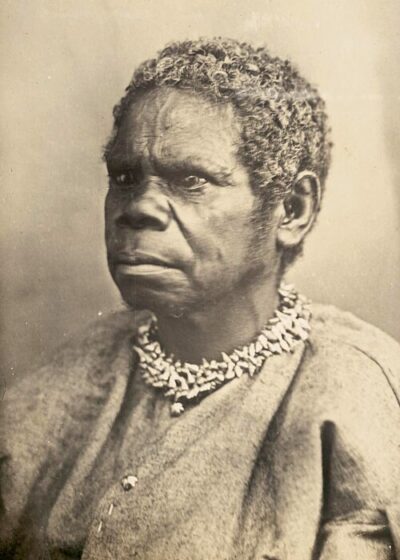
Truganini was a last full-blooded Palawa person. Born 1812, in Bruny Island. Died May 8, 1876, in Hobart.
Facts
7 facts · 2 confirmed by two sources · 0 cited · 5 from one source
Where this comes from
Papalocal keeps its own record. It started from these sources; what each one said is kept here as it was copied, so a change on their side never changes this page by itself. Tap one to read its version.
What Wikidata says · copied November 16, 2026 · revision 2553963411
- Described as
- last full-blooded Palawa person
- Other names
- Trukanini, Trugernanna, Lalla Rookh, Trugernanner, Truganina, Trigannini, Trucaminni, Trucaninny
- Born
- 1812 · 3 references
- Died
- May 8, 1876
- Born in
- Bruny Island
- Died in
- Hobart
- Citizen of
- Australia
- Occupation
- guide
- Spouse
- Wurati
- Wikipedias with a page
- 29
Wikidata item Q242064 (wikidata.org/wiki/Q242064), public domain (CC0). Copied November 16, 2026.
What Wikipedia says · copied November 16, 2026 · revision 1383308110
Truganini ( TROO-gə-NIN-ee; c. 1812 – 8 May 1876) was an Aboriginal Tasmanian woman who was widely, though incorrectly, described as the last surviving Aboriginal Tasmanian. A member of the Nuenonne people, she grew up on Bruny Island in what is now south-eastern Tasmania. During her teenage years, she saw the death and displacement of much of Tasmania's Aboriginal population as a result of British colonisation during the Black War. She became a guide to the colonial official George Augustus Robinson and accompanied him on a series of expeditions that resulted in the exile of Tasmania's remaining Aboriginal population.
Truganini was exiled to the Wybalenna Aboriginal Establishment on Flinders Island at the conclusion of the expeditions in 1835. She later spent time in the Port Phillip District (modern-day Victoria), where she became a fugitive and was tried alongside four others for the murder of a pair of whalers. After being acquitted of the crime, she was returned to Wybalenna and was later moved to Oyster Cove. By 1872, she was the only Aboriginal resident left at Oyster Cove and began to be mythologised as the last of her race, attracting the fascination of colonial scientists and the settler population.
After Truganini's death in 1876, the colonial Tasmanian government declared the island's Aboriginal population extinct. Truganini became a symbol of her people's supposed extinction and has featured prominently in art, music, and literature. The narrative that Truganini was the last Aboriginal Tasmanian has been rejected by scholars and by the contemporary Aboriginal Tasmanian community. Once cast as the final survivor of a race doomed to extinction, she has since been reframed by some as a memorial to the genocide of Indigenous Australians, and claimed by others as an anti-colonial resistance figure.
- Born, in its opening lines
- c. 1812
- Died, in its opening lines
- May 8, 1876
From the Wikipedia article “Truganini” (en.wikipedia.org/wiki/Truganini), by its contributors, under CC BY-SA 4.0 (creativecommons.org/licenses/by-sa/4.0/). Copied November 16, 2026; not changed.
Confirmed Two sources agree. Cited One source, and it names where it got it. One source One source, without a reference of its own. Sources disagree The sources disagree. We show the best-supported value and keep theirs below.
