
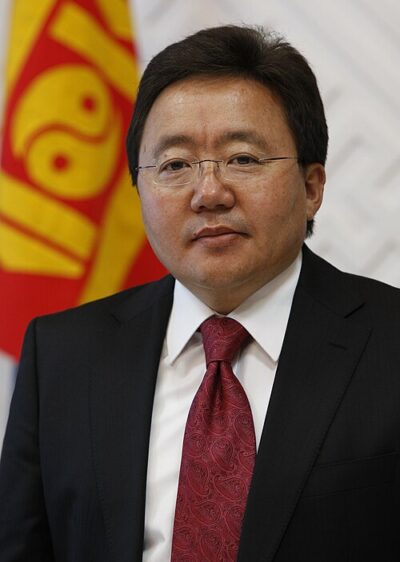
Tsakhiagiin Elbegdorj
Tsakhiagiin Elbegdorj is a Mongolian politician. Born March 30, 1963, in Zereg. Positions held include President of Mongolia (2009–2017) and Prime Minister of Mongolia (2 times) (1998–2006). Educated at Lvov Military Political High School and John F. Kennedy School of Government. Awards include Champions of the Earth and Order of Prince Yaroslav the Wise, 1st class.
Facts
19 facts · 0 confirmed by two sources · 1 cited · 17 from one source · 1 where the sources disagree
What’s different
- Born: we show March 30, 1963 (Sources disagree). Wikipedia says March 8, 1963
Where this comes from
Papalocal keeps its own record. It started from these sources; what each one said is kept here as it was copied, so a change on their side never changes this page by itself. Tap one to read its version.
What Wikidata says · copied November 16, 2026 · revision 2569111920
- Described as
- Mongolian politician
- Other names
- Elbegdorj Tsakhia, Ts.Elbegdorj, Elbegee, Tsakhia Elbegdorj
- Born
- March 30, 1963 · 3 references
- Born in
- Zereg
- Citizen of
- Mongolia · 1 reference
- Occupation
- politician · 1 reference; writer; journalist; environmentalist
- Positions held
- President of Mongolia (2009–2017); Prime Minister of Mongolia (2 times) (1998–2006)
- Political party
- Democratic Party
- Education
- Lvov Military Political High School (–1988); John F. Kennedy School of Government; University of Colorado Boulder; University of Colorado · 1 reference
- Member of
- The Elders (2022–) · 1 reference
- Awards
- Champions of the Earth (2012); Order of Prince Yaroslav the Wise, 1st class
- Website
- https://www.president.mn/eng; http://www.elbegdorj.mn/
- Wikipedias with a page
- 62
Wikidata item Q57421 (wikidata.org/wiki/Q57421), public domain (CC0). Copied November 16, 2026.
What Wikipedia says · copied November 16, 2026 · revision 1384639267
Tsakhiagiin Elbegdorj (Mongolian: Цахиагийн Элбэгдорж; born 8 March 1963), known internationally as Elbegdorj Tsakhia, is a Mongolian politician and journalist who served as the president of Mongolia from 2009 to 2017. He previously served as prime minister in 1998 and again from 2004 to 2006.
Elbegdorj was one of the key leaders of the 1990 Mongolian democratic revolution that ended 70 years of communist rule in Mongolia, and co-drafted the country's 1992 constitution that guaranteed democracy and a free market economy. Elbegdorj has been labeled by his supporters as a "freedom fighter" and the "Golden Sparrow of Democracy", alluding to a bird that comes with spring sunshine after a long, harsh winter.
Currently, Elbegdorj is a member of The Elders – established by Nelson Mandela in 2007 – that works for peace, justice, human rights and a sustainable planet. Moreover, he is a member of Club de Madrid which commits to advancing democracy worldwide. In addition, Elbegdorj is a commissioner of International Commission Against Death Penalty. Furthermore, he is a vice chairman of International Democracy Union, the international alliance of centre-right political parties. Elbegdorj is a patron of World Sustainable Development Forum. He is the Bernard and Susan Liautaud visiting fellow at Stanford University's Freeman Spogli Institute for International Studies. Elbegdorj is a president of World Mongol Federation - an international federation of Mongols around the world.
His presidential tenure has focused on fighting corruption, environmental protection, women's rights, judicial reform, civic engagement, economic liberalization and privatization, property rights, and the abolition of the death penalty.
Elbegdorj is the founder of the Ardchilal (lit. 'Democracy') newspaper – the country's first independent newspaper – and helped to establish the first independent television station in Mongolia.
- Born, in its opening lines
- March 8, 1963
From the Wikipedia article “Tsakhiagiin Elbegdorj” (en.wikipedia.org/wiki/Tsakhiagiin_Elbegdorj), by its contributors, under CC BY-SA 4.0 (creativecommons.org/licenses/by-sa/4.0/). Copied November 16, 2026; not changed.
Confirmed Two sources agree. Cited One source, and it names where it got it. One source One source, without a reference of its own. Sources disagree The sources disagree. We show the best-supported value and keep theirs below.
