
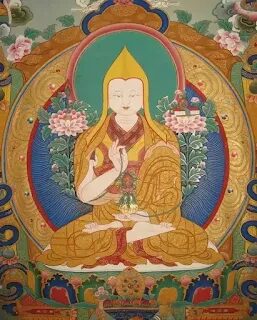
Tsongkhapa
Tsongkhapa was a Tibetan Buddhist monk, philosopher, and guru (c. 1357–1419). Born November 21, 1357, in Tsongkha. Died November 21, 1419, in Ganden Monastery. Positions held include Ganden Tripa.
Facts
10 facts · 2 confirmed by two sources · 1 cited · 7 from one source
Where this comes from
Papalocal keeps its own record. It started from these sources; what each one said is kept here as it was copied, so a change on their side never changes this page by itself. Tap one to read its version.
What Wikidata says · copied November 16, 2026 · revision 2570020044
- Described as
- Tibetan Buddhist monk, philosopher, and guru (c. 1357–1419)
- Other names
- Losang Drakpa, Je Rinpoche, Zongkapa Lobsang Zhaba, Tsong Khapa, Btsong-kha-pa, Tsongkhapa Lobzang Drakpa, bTsong-kha-pa, Tsong-kha-pa, Tsong-khapa, Tsong-Kha-Pa, Tsong-Khapa, Tsong kha pa
- Born
- November 21, 1357
- Died
- November 21, 1419 · 1 reference
- Born in
- Tsongkha
- Died in
- Ganden Monastery
- Occupation
- philosopher; writer · 1 reference
- Positions held
- Ganden Tripa
- Father
- Lubum Ge · 2 references
- Religion
- Tibetan Buddhism; Gelug
- Wikipedias with a page
- 40
Wikidata item Q323439 (wikidata.org/wiki/Q323439), public domain (CC0). Copied November 16, 2026.
What Wikipedia says · copied November 16, 2026 · revision 1368404824
Tsongkhapa (Tibetan: ཙོང་ཁ་པ་, [tsoŋˈkʰapa], meaning: "the man from Tsongkha" or "the Man from Onion Valley", c. 1357–1419) was an influential Tibetan Buddhist monk, philosopher, and tantric yogi, whose activities led to the formation of the Gelug school of Tibetan Buddhism.
His philosophical works are a grand synthesis of the Buddhist epistemological tradition of Dignāga and Dharmakīrti, the Cittamatra philosophy of the mind, and the madhyamaka philosophy of Nāgārjuna and Candrakīrti.
Central to his philosophical and soteriological teachings is "a radical view of emptiness" which sees all phenomena as devoid of intrinsic nature. This view of emptiness is not a kind of nihilism or a total denial of existence. Instead, it sees phenomena as existing "interdependently, relationally, non-essentially, conventionally" (which Tsongkhapa terms "mere existence").
Tsongkhapa emphasized the importance of philosophical reasoning in the path to liberation. According to Tsongkhapa, meditation must be paired with rigorous reasoning in order "to push the mind and precipitate a breakthrough in cognitive fluency and insight."
- Born, in its opening lines
- 1357
- Died, in its opening lines
- 1419
From the Wikipedia article “Je Tsongkhapa” (en.wikipedia.org/wiki/Je_Tsongkhapa), by its contributors, under CC BY-SA 4.0 (creativecommons.org/licenses/by-sa/4.0/). Copied November 16, 2026; not changed.
Confirmed Two sources agree. Cited One source, and it names where it got it. One source One source, without a reference of its own. Sources disagree The sources disagree. We show the best-supported value and keep theirs below.
