
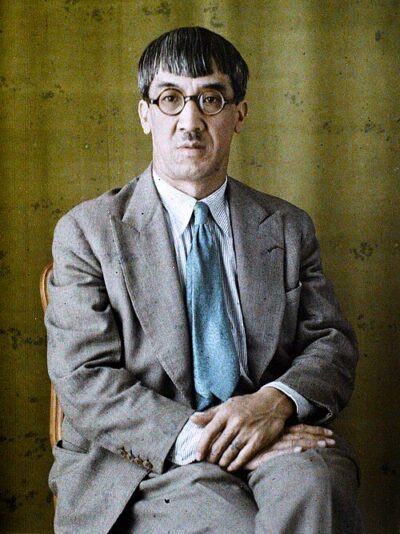
Tsuguharu Foujita
Tsuguharu Foujita was a French painter. Born November 27, 1886, in Shin-ogawamachi. Died January 29, 1968, in Zurich. Educated at Tokyo Academy of Fine Arts. Awards include Officer of the Legion of Honour and Order of the Sacred Treasure, 1st Class.
Facts
19 facts · 2 confirmed by two sources · 6 cited · 11 from one source
Where this comes from
Papalocal keeps its own record. It started from these sources; what each one said is kept here as it was copied, so a change on their side never changes this page by itself. Tap one to read its version.
What Wikidata says · copied November 18, 2026 · revision 2565965454
- Described as
- French painter (1886-1968)
- Other names
- Tsugouharu Foujita, Reonāru Fujita, Tsugouharu Fujita, Leonard Foujita, Tsugouharu Leonard Foujita, Tsuguharu Fujita, Fujita Tsuguji, Léonard Foujita, Leonard Tsuguoharu Foujita, Léonard-Tsuguhara Foujita, Fujita, Foujita
- Born
- November 27, 1886 · 14 references
- Died
- January 29, 1968 · 2 references
- Born in
- Shin-ogawamachi
- Died in
- Zurich
- Cause of death
- prostate cancer · 1 reference
- Citizen of
- Japan · 1 reference; France (1955–)
- Occupation
- painter · 1 reference; printmaker; illustrator · 2 references; draftsperson · 1 reference
- Education
- Tokyo Academy of Fine Arts
- Genre
- portrait
- Awards
- Officer of the Legion of Honour (1957) · 1 reference; Order of the Sacred Treasure, 1st Class · 1 reference
- Spouse
- Youki Desnos - Foujita; Tomi Tokita · 1 reference
- Siblings
- Tsuguo Fujita · 1 reference
- Religion
- Catholicism (1959–)
- Wikipedias with a page
- 24
Wikidata item Q261846 (wikidata.org/wiki/Q261846), public domain (CC0). Copied November 18, 2026.
What Wikipedia says · copied November 18, 2026 · revision 1375941544
Léonard Tsuguharu Foujita (藤田 嗣治, Fujita Tsuguharu; 27 November 1886 – 29 January 1968) was a Japanese-French painter. After studying Western-style painting in Japan, Foujita travelled to Paris, where he encountered the international modern art scene of the Montparnasse neighbourhood and developed an eclectic style that borrowed from both Japanese and European artistic traditions.
With his unusual fashion and distinctive figurative style, Foujita reached the height of his fame in 1920s Paris. His watercolour and oil works of nudes, still lifes, and self-portraits were a commercial success and he became a notable figure in the Parisian art scene.
Foujita spent three years traveling through South and North America before returning to Japan in 1933, documenting his observations in sketches and paintings. Upon his return home, Foujita became an official war artist during World War II, illustrating battle scenes to raise the morale of the Japanese troops and citizens. His oil paintings won him acclaim during the war, but public perception of him became mixed following the Japanese defeat.
Without significant prospects in the post-war Japanese art scene, Foujita returned to France in 1950, where he would spend the rest of his life. He received French nationality in 1955 and converted to Catholicism in 1959. His latter years were spent working on the frescoes for a small, Romanesque chapel in Reims that he had constructed. He died in 1968, shortly after the chapel officially opened.
In France, Foujita is remembered as part of the années folles of the 1920s, but public opinion of him in Japan remains mixed due to his monumental depictions of the war. Retrospective exhibitions organized since 2006 in Japan have sought to establish Foujita's place in Japanese twentieth-century art history.
- Born, in its opening lines
- November 27, 1886
- Died, in its opening lines
- January 29, 1968
From the Wikipedia article “Tsuguharu Foujita” (en.wikipedia.org/wiki/Tsuguharu_Foujita), by its contributors, under CC BY-SA 4.0 (creativecommons.org/licenses/by-sa/4.0/). Copied November 18, 2026; not changed.
Confirmed Two sources agree. Cited One source, and it names where it got it. One source One source, without a reference of its own. Sources disagree The sources disagree. We show the best-supported value and keep theirs below.
