
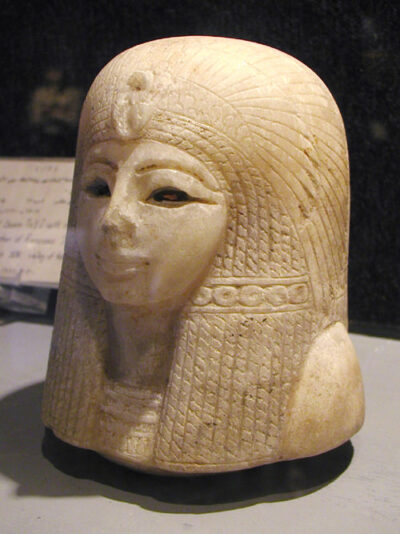
Tuya
Tuya was an ancient Egyptian queen consort of Seti I. Born 1325 BC. Died 1258 BC, in Thebes. Positions held include Divine Adoratrice of Amun.
Facts
11 facts · 0 confirmed by two sources · 0 cited · 11 from one source
Where this comes from
Papalocal keeps its own record. It started from these sources; what each one said is kept here as it was copied, so a change on their side never changes this page by itself. Tap one to read its version.
What Wikidata says · copied November 17, 2026 · revision 2521284778
- Described as
- ancient Egyptian queen consort of Seti I
- Other names
- Tuyo, Tuy, Mut-Tuya
- Born
- 1325 BC
- Died
- 1258 BC
- Died in
- Thebes
- Buried in
- QV80 · 1 reference
- Citizen of
- Ancient Egypt
- Positions held
- Divine Adoratrice of Amun
- Spouse
- Seti I
- Children
- Ramesses II; Tia; Nebchasetnebet; Henutmire
- Wikipedias with a page
- 26
Wikidata item Q270381 (wikidata.org/wiki/Q270381), public domain (CC0). Copied November 17, 2026.
What Wikipedia says · copied November 17, 2026 · revision 1381028375
Tuya (also called Tuy or more rarely Mut-Tuya or Muty; in transliteration from hieroglyphic, Twy, Twjȝ, or Twyȝ, as well as Mwt-Twjȝ,; in cuneiform texts from the Hittite correspondence, Tūya, SALTu-u-ia.), meaning "the admirable one" or "one who is admirable", was the wife of Pharaoh Seti I of the Nineteenth Dynasty of Egypt and mother of Tia, Ramesses II, and possibly Henutmire.
She was the daughter of Raia (Rʿjȝ), Lieutenant in the Chariotry, by his wife Ruya or Tuya (the name is partly broken: [R/T]wjȝ). Seti I and Tuya's daughter Tia (Ṯjȝ) was married to a high-ranking civil servant who was also called Tia (Ṯjȝ), the son of Amenwahsu (Jmn-wȝḥ-sw). The vast majority of Tuya's attestations as queen date to the reign of her son, making it less than completely certain that she bore the title of King's Great Wife during the reign of her husband. On the other hand, as mother of king's only known son, she might well have become Seti's chief queen, unlike another spouse, the royal daughter Tanodjmy.
It is worth noting that Tuya is called King's Ornament (ḫkr.t-nswt) in the Ramesseum. The meaning of this title is similar to that of a court lady-in-waiting. Obsomer believes that, since according to Troy's compilation this title was no longer held by queens after the Eleventh Dynasty, Tuya's title was very likely in fact "mistress of the King's Ornaments" (ḥnwt ḫkr.t-nswt), the first part of which is broken off and has not survived. However, Queen Tiye of the Eighteenth Dynasty very clearly held this title; therefore Tuya was very likely also a King's Ornament. In Tuya's case, this was probably a title she held during the reign of Horemheb and retained honorifically thereafter. Although during the reign of Seti I it cannot be proven that Tuya held any title, at least this title should have continued to belong to her.
As the mother of Ramesses II, Tuya enjoyed a privileged existence of a respected king's mother. Ramesses dedicated a monumental structure within his mortuary temple, the Ramesseum, to his mother, and also constructed a fine new tomb for her in the section of the Valley of the Queens that he developed for the burials of the women in his family. Following the peace treaty between Egypt and Hatti in Year 21 of Ramesses II (1259 BC according to the "Low Chronology"), Tuya sent congratulatory letters to the Hittite great king Ḫattušili III and to his queen Puduḫepa, who she addressed as her symbolic "brother" and "sister", respectively. However, by the time of the inauguration of Ramesses II's temple at Abu Simbel in Year 24 (1256 BC), Tuya appears to have been dead.
From the Wikipedia article “Tuya (queen)” (en.wikipedia.org/wiki/Tuya_(queen)), by its contributors, under CC BY-SA 4.0 (creativecommons.org/licenses/by-sa/4.0/). Copied November 17, 2026; not changed.
Confirmed Two sources agree. Cited One source, and it names where it got it. One source One source, without a reference of its own. Sources disagree The sources disagree. We show the best-supported value and keep theirs below.
