
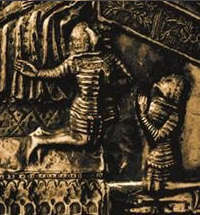
Tvrtko I of Bosnia
Tvrtko I of Bosnia was a founder and first king of the Kingdom of Bosnia (r. 1377–91). Born August 5, 1338, in Srebrenik. Died March 14, 1391, in Bobovac. Positions held include Ban.
Facts
17 facts · 1 confirmed by two sources · 0 cited · 15 from one source · 1 where the sources disagree
What’s different
- Died: we show March 14, 1391 (Sources disagree). Wikipedia says March 10, 1391
Where this comes from
Papalocal keeps its own record. It started from these sources; what each one said is kept here as it was copied, so a change on their side never changes this page by itself. Tap one to read its version.
What Wikidata says · copied November 16, 2026 · revision 2558265887
- Described as
- founder and first king of the Kingdom of Bosnia (r. 1377–91)
- Other names
- Tvrtko I Kotromanić, Stephen Tvrtko I
- Born
- August 5, 1338
- Died
- March 14, 1391
- Born in
- Srebrenik
- Died in
- Bobovac
- Buried in
- Visoko
- Occupation
- sovereign
- Positions held
- Ban
- Spouse
- Dorothea of Bulgaria
- Children
- Ostoja of Bosnia; Helen of Bosnia; Vuk Banić; Tvrtko II of Bosnia · 1 reference
- Father
- Vladislaus of Bosnia
- Mother
- Jelena Šubić
- Siblings
- Vuk, Ban of Bosnia; Catherine of Bosnia, Countess of Cilli · 1 reference
- Religion
- Catholicism
- Wikipedias with a page
- 34
Wikidata item Q319605 (wikidata.org/wiki/Q319605), public domain (CC0). Copied November 16, 2026.
What Wikipedia says · copied November 16, 2026 · revision 1378520565
Stephen Tvrtko I (Serbo-Croatian: Stjepan/Stefan Tvrtko / Стјепан/Стефан Твртко; c. 1338 – 10 March 1391) was the first king of Bosnia. A member of the House of Kotromanić, he succeeded his uncle Stephen II as the ban of Bosnia in 1353. As he was a minor at the time, Tvrtko's father, Vladislav, briefly ruled as regent, followed by Tvrtko's mother, Jelena. Early in his personal rule, Tvrtko quarrelled with his country's Roman Catholic clergy but later enjoyed cordial relations with all the religious communities in his realm. After initial difficulties—the loss of large parts of Bosnia to his overlord, King Louis I of Hungary, and being briefly deposed by his magnates—Tvrtko's power grew considerably. He conquered some remnants of the neighbouring Serbian Empire in 1373, after the death of its last ruler and his distant relative, Uroš the Weak. In 1377, he had himself crowned king of Bosnia and Serbia, claiming to be the heir of Serbia's extinct Nemanjić dynasty.
As the Kingdom of Bosnia continued to expand, Tvrtko's attention shifted to the Adriatic coast. He gained control of the entire Primorje region and the major maritime cities of the area, established new settlements and started building a navy, but never succeeded in subjugating the lords of the independent Serbian territories. The death of King Louis and the accession of Queen Mary in 1382 allowed Tvrtko to take advantage of the ensuing succession crisis in Hungary and Croatia. After bitter fighting, from 1385 to 1390, Tvrtko succeeded in conquering large parts of Dalmatia, and Croatia proper. Following the Battle of Kosovo in 1389, his tenuous claim to Serbia became a mere fiction, as the Serbian rulers he sought to subdue became vassals of the victorious Ottoman Empire. The Ottoman Turks also launched their first attacks on Bosnia during Tvrtko's reign, but his army was able to repel them. Tvrtko's sudden death in 1391 prevented him from solidifying the Kotromanić hold on Croatian lands.
Tvrtko is widely considered one of Bosnia's greatest medieval rulers, having enlarged the country's borders to their greatest extent, left a strong economy, and improved the living standards of his subjects. He was survived by at least one son, Tvrtko II, but was succeeded by Dabiša, under whom Tvrtko's burgeoning realm began to decay.
- Born, in its opening lines
- c. 1338
- Died, in its opening lines
- March 10, 1391
From the Wikipedia article “Tvrtko I of Bosnia” (en.wikipedia.org/wiki/Tvrtko_I_of_Bosnia), by its contributors, under CC BY-SA 4.0 (creativecommons.org/licenses/by-sa/4.0/). Copied November 16, 2026; not changed.
Confirmed Two sources agree. Cited One source, and it names where it got it. One source One source, without a reference of its own. Sources disagree The sources disagree. We show the best-supported value and keep theirs below.
