
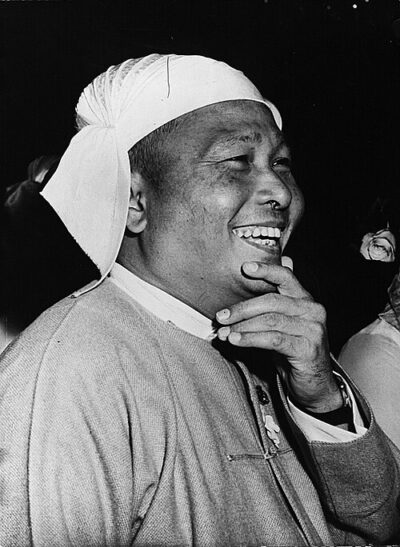
U Nu
U Nu was a Burmese nationalist and political figure. Born May 25, 1907, in Wakema. Died February 14, 1995, in Yangon. Positions held include Prime Minister of Myanmar (1948–1956). Educated at University of Yangon and Basic Education High School No. 2 Dagon.
Facts
12 facts · 2 confirmed by two sources · 3 cited · 7 from one source
Where this comes from
Papalocal keeps its own record. It started from these sources; what each one said is kept here as it was copied, so a change on their side never changes this page by itself. Tap one to read its version.
What Wikidata says · copied November 16, 2026 · revision 2562793615
- Described as
- Burmese nationalist and political figure (1907-1995)
- Other names
- Thakin Nu, Nu
- Born
- May 25, 1907 · 7 references
- Died
- February 14, 1995 · 7 references
- Born in
- Wakema · 2 references
- Died in
- Yangon · 1 reference
- Citizen of
- Myanmar
- Occupation
- politician · 1 reference; writer · 1 reference
- Positions held
- Prime Minister of Myanmar (1948–1956)
- Political party
- Anti-Fascist People's Freedom League
- Education
- University of Yangon; Basic Education High School No. 2 Dagon
- Religion
- Buddhism
- Wikipedias with a page
- 44
Wikidata item Q316384 (wikidata.org/wiki/Q316384), public domain (CC0). Copied November 16, 2026.
What Wikipedia says · copied November 16, 2026 · revision 1379912275
Nu (Burmese: ဦးနု; pronounced [ʔú nṵ]; 25 May 1907 – 14 February 1995), commonly known as U Nu and also by the honorific name Thakin Nu, was a prominent Burmese statesman and the first Prime Minister of Union of Burma. He was educated at Rangoon University, where he developed his political ideas and became actively involved in the student movement. Nu's involvement in the nationalist movement deepened during his university years, and he quickly emerged as a leading figure advocating for Burma's independence from British colonial rule.
He played a crucial role in the Anti-Fascist People's Freedom League (AFPFL), the primary political organization leading the fight for independence. Following Burma's independence in 1948, Nu became the country's first Prime Minister under the provisions of the 1947 Constitution of the Union of Burma. His tenure was marked by efforts to rebuild the war-torn nation, establish democratic governance, and navigate the complexities of ethnic and political divisions within Burma. Nu's administration faced numerous challenges, including economic difficulties, internal insurgencies, and the task of unifying a diverse population.
During his time in office, Nu implemented several significant reforms, including land redistribution policies and initiatives to promote education and healthcare. He also pursued a policy of neutrality in foreign affairs, aligning Burma with neither the Western bloc nor the Soviet Union during the Cold War. However, his government struggled with internal dissent and regional insurgencies, leading to political instability.
Nu's first term as Prime Minister ended in 1958, but he briefly returned to power in 1960. However, his second tenure was cut short by a military coup in 1962, led by General Ne Win. Following the coup, Nu was placed under house arrest and later allowed to go into exile. He continued to be an influential political figure and an advocate for democracy until his death on 14 February 1995. Nu's legacy is remembered for his dedication to Burma's independence, his efforts to establish democratic governance, and his complex role in the nation's turbulent political history.
- Born, in its opening lines
- May 25, 1907
- Died, in its opening lines
- February 14, 1995
From the Wikipedia article “U Nu” (en.wikipedia.org/wiki/U_Nu), by its contributors, under CC BY-SA 4.0 (creativecommons.org/licenses/by-sa/4.0/). Copied November 16, 2026; not changed.
Confirmed Two sources agree. Cited One source, and it names where it got it. One source One source, without a reference of its own. Sources disagree The sources disagree. We show the best-supported value and keep theirs below.
