
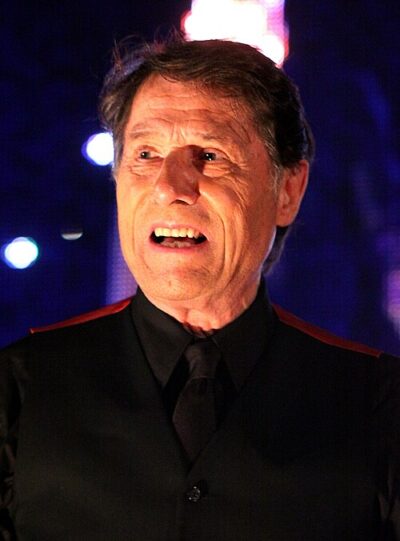
Udo Jürgens
Udo Jürgens was an Austrian singer and composer. Born September 30, 1934, in Klagenfurt am Wörthersee. Died December 21, 2014, in Münsterlingen. Known for Der Mann mit dem Fagott, Merci Chérie and Ich war noch niemals in New York. Awards include Officer's Cross of the Order of Merit of the Federal Republic of Germany, Golden Feather and Ring of Honour of the City of Vienna.
Facts
52 facts · 2 confirmed by two sources · 12 cited · 38 from one source
Where this comes from
Papalocal keeps its own record. It started from these sources; what each one said is kept here as it was copied, so a change on their side never changes this page by itself. Tap one to read its version.
What Wikidata says · copied November 16, 2026 · revision 2561394359
- Described as
- Austrian singer and composer (1934–2014)
- Other names
- Udo Jürgen Bockelmann, Udo Juergens, Jürgen Udo Bockelmann
- Born
- September 30, 1934 · 7 references
- Died
- December 21, 2014 · 7 references
- Born in
- Klagenfurt am Wörthersee · 1 reference
- Died in
- Münsterlingen · 2 references
- Buried in
- Vienna Central Cemetery · 1 reference
- Cause of death
- heart failure
- Name at birth
- Jürgen Udo Bockelmann · 1 reference
- Citizen of
- Austria; Switzerland
- Occupation
- actor · 2 references; singer · 2 references; composer · 1 reference; pianist · 1 reference; recording artist; writer · 1 reference
- Genre
- pop music; schlager music; chanson · 1 reference
- Instrument
- piano; voice
- Known for
- Der Mann mit dem Fagott; Merci Chérie; Ich war noch niemals in New York; Lieb Vaterland; Die Krone der Schöpfung
- Awards
- Officer's Cross of the Order of Merit of the Federal Republic of Germany (1994) · 1 reference; Golden Feather (2000); Ring of Honour of the City of Vienna; Romy (2011); Decoration of Honour in Gold for Services to the State of Vienna; Grand Decoration of Honour for Services to the Republic of Austria; Steiger Award; Bambi Award (1970); Amadeus Austrian Music Awards (2000); Berufstitel Professor; First prize of the Eurovision Song Contest (1966) · 1 reference; Paul-Lincke-Ring (1981) · 1 reference; Osgar (2008); Berliner Bär (2007); Goldene Stimmgabel (4 times) (1984, 1986, 1992, 2001)
- Spouse
- Panja Jürgens (1964–1989); Corinna Jürgens (1999–2006)
- Children
- John Jürgens · 1 reference; Jenny Jürgens; Gloria Burda · 4 references; Sonja Jürgens
- Father
- Rudolf Bockelmann
- Mother
- Käthe Bockelmann
- Siblings
- Manfred Bockelmann; John Bockelmann
- Religion
- atheism · 2 references
- Website
- https://www.udojuergens.de/
- Wikipedias with a page
- 55
Wikidata item Q155236 (wikidata.org/wiki/Q155236), public domain (CC0). Copied November 16, 2026.
What Wikipedia says · copied November 16, 2026 · revision 1346023861
Udo Jürgens (born Jürgen Udo Bockelmann; 30 September 1934 – 21 December 2014) was an Austrian composer and singer of popular music whose career spanned over 50 years. He won the Eurovision Song Contest 1966 for Austria, composed close to 1,000 songs, and sold over 104 million records. In 2007, he additionally obtained Swiss citizenship.
He is credited with broadening German-language pop music beyond the traditional post-war "schlager" (hit song) in the 1950s by infusing it with a modern pop appeal and French chanson style. His compositions and arrangements attracted fans of all ages, and he continued to fill venues in Germany, Austria, and Switzerland until his death at age 80.
- Born, in its opening lines
- September 30, 1934
- Died, in its opening lines
- December 21, 2014
From the Wikipedia article “Udo Jürgens” (en.wikipedia.org/wiki/Udo_Jürgens), by its contributors, under CC BY-SA 4.0 (creativecommons.org/licenses/by-sa/4.0/). Copied November 16, 2026; not changed.
Confirmed Two sources agree. Cited One source, and it names where it got it. One source One source, without a reference of its own. Sources disagree The sources disagree. We show the best-supported value and keep theirs below.
