
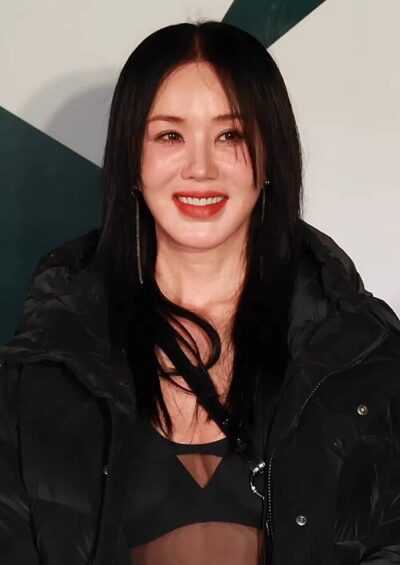
Uhm Jeong-hwa is a South Korean singer and actress. Born August 17, 1969, in Jecheon. Educated at Bukwon Girls' High School. Awards include Mnet Asian Music Award for Best Female Artist.
Facts
13 facts · 1 confirmed by two sources · 1 cited · 11 from one source
Where this comes from
Papalocal keeps its own record. It started from these sources; what each one said is kept here as it was copied, so a change on their side never changes this page by itself. Tap one to read its version.
What Wikidata says · copied November 18, 2026 · revision 2547943461
- Described as
- South Korean singer and actress
- Other names
- Eom Jeong-hwa, Jeong-hwa Eom, Uhm Jung-hwa
- Born
- August 17, 1969 · 2 references
- Born in
- Jecheon · 1 reference
- Citizen of
- South Korea
- Occupation
- singer; actor; dancer
- Education
- Bukwon Girls' High School
- Member of
- Refund Sisters · 1 reference
- Genre
- K-pop
- Instrument
- voice
- Awards
- Mnet Asian Music Award for Best Female Artist (1999)
- Siblings
- Uhm Tae-woong
- Website
- http://www.uhmjunghwa.kr
- Wikipedias with a page
- 24
Wikidata item Q272329 (wikidata.org/wiki/Q272329), public domain (CC0). Copied November 18, 2026.
What Wikipedia says · copied November 18, 2026 · revision 1383802266
Uhm Jung-hwa (Korean: 엄정화; born August 17, 1969) is a South Korean singer, actress and dancer. Uhm is considered to be one of the most influential women in the Korean entertainment industry, finding success in both music and film. Her legacy and career reinventions have given her the nickname of "Korean Madonna".
Uhm began her career in 1989 as a chorus member for the broadcasting company MBC. She starred in the romantic drama film On a Windy Day, We Must Go to Apgujeong (1993) and released her debut studio album Sorrowful Secret that same year. Though both releases found limited audiences, the album's lead single, "Pupil", helped to establish a sensual image for Uhm.
She pivoted to dance music with the single "Sad Expectation" (1996), and found success with "Rose of Betrayal" (배반의 장미) from her third studio album, After Love (1997). Subsequent album releases Invitation (1998) and 005.1999.06 (1999) were bolstered by a string of hit singles: "Poison", "Invitation", "I Don't Know" (몰라), and "Festival", which gained status as her signature songs.
In 2001, Uhm began to focus on her acting career. Her performance in the erotic comedy Marriage Is a Crazy Thing (2002) won Best Actress at the 39th Baeksang Arts Awards, a category she received another nomination for with Princess Aurora (2006) and won again with Dancing Queen (2012).
Her 2000s musical output saw declining commercial reception but greater appeal with critics. Uhm began experimenting with electronica on Self Control (2004), and funk on Prestige (2006), the latter of which won Best Dance and Electronic Album at the 4th Korean Music Awards. In 2008, she experienced a commercial resurgence with the single "D.I.S.C.O". Following a nearly decade-long hiatus from music, she released her tenth studio album The Cloud Dream of the Nine in 2017.
- Born, in its opening lines
- August 17, 1969
From the Wikipedia article “Uhm Jung-hwa” (en.wikipedia.org/wiki/Uhm_Jung-hwa), by its contributors, under CC BY-SA 4.0 (creativecommons.org/licenses/by-sa/4.0/). Copied November 18, 2026; not changed.
Confirmed Two sources agree. Cited One source, and it names where it got it. One source One source, without a reference of its own. Sources disagree The sources disagree. We show the best-supported value and keep theirs below.
