
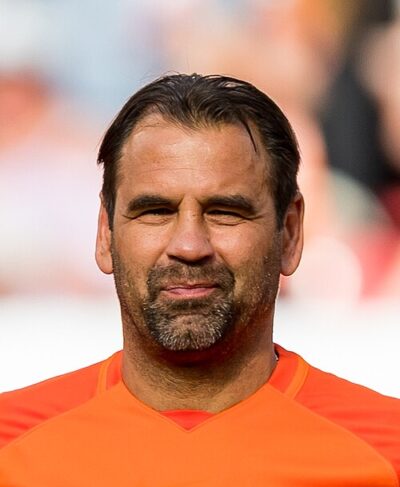
Ulf Kirsten
Ulf Kirsten is a German footballer. Born December 4, 1965, in Riesa. Teams include Dynamo Dresden (1983–1990), Germany men's national association football team (1992–2000) and Bayer 04 Leverkusen (1990–2003).
Facts
15 facts · 1 confirmed by two sources · 3 cited · 11 from one source
Where this comes from
Papalocal keeps its own record. It started from these sources; what each one said is kept here as it was copied, so a change on their side never changes this page by itself. Tap one to read its version.
What Wikidata says · copied November 16, 2026 · revision 2569016226
- Described as
- German footballer
- Born
- December 4, 1965 · 1 reference
- Born in
- Riesa · 1 reference
- Citizen of
- Germany; East Germany
- Occupation
- association football player · 1 reference; association football coach; actor · 1 reference
- Teams
- Dynamo Dresden (1983–1990); Germany men's national association football team (1992–2000); Bayer 04 Leverkusen (1990–2003); East Germany national under-21 football team; East Germany national football team (1985–1990)
- Sport
- association football
- Children
- Benjamin Kirsten
- Height
- 1.75 m (5 ft 9 in)
- Wikipedias with a page
- 40
Wikidata item Q310519 (wikidata.org/wiki/Q310519), public domain (CC0). Copied November 16, 2026.
What Wikipedia says · copied November 16, 2026 · revision 1381786954
Ulf Kirsten (German pronunciation: [ʊlf ˈkɪʁstn̩]; born 4 December 1965) is a German former professional footballer who played as a striker. Nicknamed Der Schwatte (dialect for Der Schwarze, 'The Black One'), he is the first player in history to reach a total 100 caps playing with two different national teams (first for East Germany, then Reunified Germany). Kirsten's biggest success was the victory of the 1992–93 DFB-Pokal.
- Born, in its opening lines
- December 4, 1965
From the Wikipedia article “Ulf Kirsten” (en.wikipedia.org/wiki/Ulf_Kirsten), by its contributors, under CC BY-SA 4.0 (creativecommons.org/licenses/by-sa/4.0/). Copied November 16, 2026; not changed.
Confirmed Two sources agree. Cited One source, and it names where it got it. One source One source, without a reference of its own. Sources disagree The sources disagree. We show the best-supported value and keep theirs below.
