
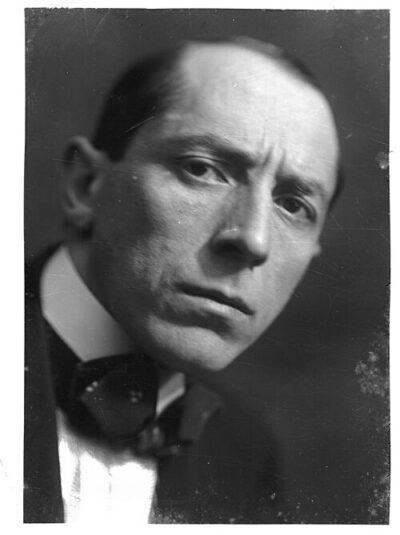
Umberto Boccioni
Umberto Boccioni was an Italian painter and sculptor. Born October 19, 1882, in Reggio Calabria. Died August 17, 1916, in Verona. Known for The City Rises, Unique Forms of Continuity in Space and The Street Enters the House. Educated at Academy of Fine Arts of Rome and Accademia di Belle Arti di Venezia.
Facts
28 facts · 2 confirmed by two sources · 11 cited · 15 from one source
Where this comes from
Papalocal keeps its own record. It started from these sources; what each one said is kept here as it was copied, so a change on their side never changes this page by itself. Tap one to read its version.
What Wikidata says · copied November 16, 2026 · revision 2558266912
- Described as
- Italian painter and sculptor (1882-1916)
- Born
- October 19, 1882 · 11 references
- Died
- August 17, 1916 · 9 references
- Born in
- Reggio Calabria · 2 references
- Died in
- Verona · 2 references
- Buried in
- Monumental Cemetery of Verona
- Cause of death
- horse fall
- Citizen of
- Kingdom of Italy
- Occupation
- painter · 2 references; sculptor · 2 references; draftsperson · 2 references; photographer · 1 reference; art critic · 1 reference; printmaker · 1 reference; artist · 1 reference
- Education
- Academy of Fine Arts of Rome; Accademia di Belle Arti di Venezia
- Genre
- figurative art; portrait · 1 reference; Veduta · 1 reference; landscape painting · 1 reference
- Known for
- The City Rises; Unique Forms of Continuity in Space; The Street Enters the House; Charge of the Lancers · 1 reference; Horse + Rider + Apartment house · 1 reference; Sintesi plastica di una figura seduta (Silvia) · 1 reference; Study for States of Mind: Those Who Go · 1 reference
- Mother
- Cecilia Forlani
- Wikipedias with a page
- 54
Wikidata item Q152797 (wikidata.org/wiki/Q152797), public domain (CC0). Copied November 16, 2026.
What Wikipedia says · copied November 16, 2026 · revision 1381445153
Umberto Boccioni (US: ; Italian: [umˈbɛrto botˈtʃoːni]; 19 October 1882 – 17 August 1916) was an influential Italian painter and sculptor. He helped shape the revolutionary aesthetic of the Futurism movement as one of its principal figures. Despite his short life, his approach to the dynamism of form and the deconstruction of solid mass guided artists long after his death. His works are held by many public art museums, and in 1988 the Metropolitan Museum of Art in New York City organized a major retrospective of 100 pieces.
- Born, in its opening lines
- October 19, 1882
- Died, in its opening lines
- August 17, 1916
From the Wikipedia article “Umberto Boccioni” (en.wikipedia.org/wiki/Umberto_Boccioni), by its contributors, under CC BY-SA 4.0 (creativecommons.org/licenses/by-sa/4.0/). Copied November 16, 2026; not changed.
Confirmed Two sources agree. Cited One source, and it names where it got it. One source One source, without a reference of its own. Sources disagree The sources disagree. We show the best-supported value and keep theirs below.
