
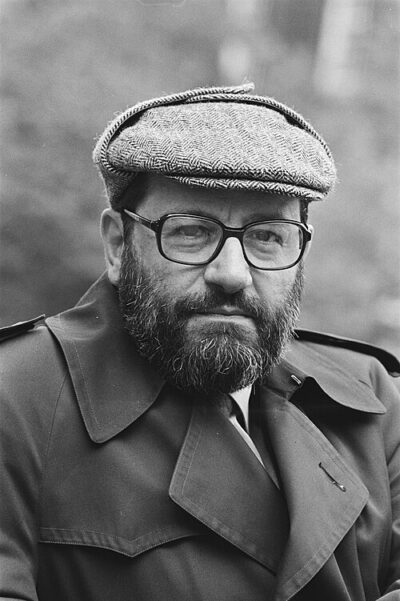
Umberto Eco
Umberto Eco was an Italian semiotician, essayist, philosopher, literary critic, and novelist. Born January 5, 1932, in Alessandria. Died February 19, 2016, in Milan. Known for The Name of the Rose, Misreadings and Foucault's Pendulum. Educated at University of Turin. Awards include Officer of the Legion of Honour, Commandeur des Arts et des Lettres and Pour le Mérite for Sciences and Arts order.
Facts
59 facts · 2 confirmed by two sources · 14 cited · 43 from one source
Where this comes from
Papalocal keeps its own record. It started from these sources; what each one said is kept here as it was copied, so a change on their side never changes this page by itself. Tap one to read its version.
What Wikidata says · copied November 16, 2026 · revision 2569017639
- Described as
- Italian semiotician, essayist, philosopher, literary critic, and novelist (1932–2016)
- Other names
- Humberto Eco, Dedalus, Umberto Eko, Oumperto Eko, Eco Umberto, U. Eco
- Born
- January 5, 1932 · 22 references
- Died
- February 19, 2016 · 16 references
- Born in
- Alessandria · 4 references
- Died in
- Milan · 3 references
- Cause of death
- pancreatic cancer
- Citizen of
- Italy (1946–) · 1 reference; Kingdom of Italy (–1946)
- Occupation
- philosopher · 3 references; novelist · 1 reference; essayist · 1 reference; pedagogue; screenwriter; translator; university teacher · 2 references; semiologist · 2 references
- Worked for
- University of Bologna · 1 reference; Collège de France · 1 reference
- Education
- University of Turin (–1954) · 2 references
- Member of
- College of 'Pataphysics; CICAP; Royal Academy of Science, Letters and Fine Arts of Belgium; American Academy of Arts and Letters; International Association for Semiotic Studies; Accademia Nazionale dei Lincei (2010–) · 1 reference
- Genre
- essay
- Known for
- The Name of the Rose; Misreadings; Foucault's Pendulum; Apocalypse Postponed; How to Write a Thesis; On Ugliness
- Awards
- Officer of the Legion of Honour; Commandeur des Arts et des Lettres; Pour le Mérite for Sciences and Arts order; Knight Commander's Cross of the Order of Merit of the Federal Republic of Germany; Honorary doctor of the Free University of Berlin; Honorary doctor of the University of Liège; honorary doctor of Tel Aviv University; honorary doctor of the University of Uppsala; honorary doctorate of the University of Glasgow; honorary doctor of the University of Athens; Honorary Doctorate of University of Buenos Aires; honorary doctor of Loyola University Chicago; honorary doctor of the University of Kent; Gold Medal of the Italian Order of Merit for Culture and Art · 1 reference; Strega Prize (1981)
- Field
- medieval philosophy; media culture; semiology · 1 reference; structural linguistics; non-fiction literature; historical novel
- Spouse
- Renate Ramge (1962–) · 1 reference
- Children
- Stefano Eco · 1 reference
- Religion
- atheism · 1 reference
- Lived in
- Alessandria; Milan; Urbino
- Website
- http://umbertoeco.it
- Wikipedias with a page
- 151
Wikidata item Q12807 (wikidata.org/wiki/Q12807), public domain (CC0). Copied November 16, 2026.
What Wikipedia says · copied November 16, 2026 · revision 1385654392
Umberto Eco (5 January 1932 – 19 February 2016) was an Italian medievalist, philosopher, semiotician, novelist, cultural critic, and political and social commentator. In English, he is best known for his popular 1980 novel The Name of the Rose, a historical mystery combining semiotics in fiction with biblical analysis, medieval studies and literary theory, as well as Foucault's Pendulum, his 1988 novel which touches on the history of occultism and its contemporary interpretation through the new age movement.
Eco wrote prolifically throughout his life, with his output including children's books, translations from French and English, in addition to a twice-monthly newspaper column "La Bustina di Minerva" (Minerva's Matchbook) in the magazine L'Espresso beginning in 1985, with his last column (a critical appraisal of the Romantic paintings of Francesco Hayez) appearing 27 January 2016. At the time of his death, he was an Emeritus professor at the University of Bologna, where he taught for much of his life. In the 21st century, he has continued to gain recognition for his 1995 essay "Ur-Fascism", where Eco lists fourteen general properties he believes comprise fascist ideologies.
- Born, in its opening lines
- January 5, 1932
- Died, in its opening lines
- February 19, 2016
From the Wikipedia article “Umberto Eco” (en.wikipedia.org/wiki/Umberto_Eco), by its contributors, under CC BY-SA 4.0 (creativecommons.org/licenses/by-sa/4.0/). Copied November 16, 2026; not changed.
Confirmed Two sources agree. Cited One source, and it names where it got it. One source One source, without a reference of its own. Sources disagree The sources disagree. We show the best-supported value and keep theirs below.
