
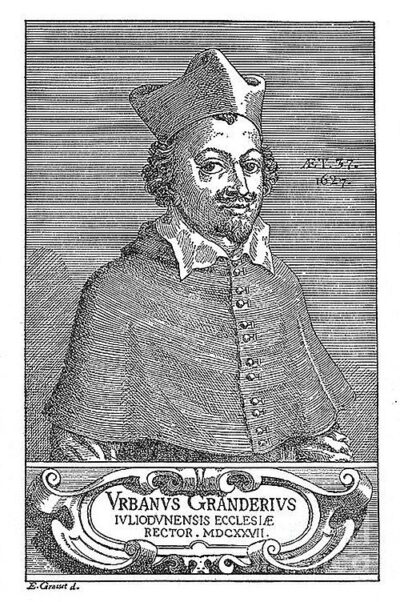
Urbain Grandier was a French priest. Born 1590, in Bouère. Died August 18, 1634, in Loudun.
Facts
8 facts · 0 confirmed by two sources · 1 cited · 6 from one source · 1 where the sources disagree
What’s different
- Born: we show 1590 (Sources disagree). Wikipedia says August 18, 1634
Where this comes from
Papalocal keeps its own record. It started from these sources; what each one said is kept here as it was copied, so a change on their side never changes this page by itself. Tap one to read its version.
What Wikidata says · copied November 17, 2026 · revision 2567277595
- Described as
- French priest
- Born
- 1590 · 10 references
- Died
- August 18, 1634 · 2 references
- Born in
- Bouère
- Died in
- Loudun
- Cause of death
- death by burning
- Citizen of
- Kingdom of France
- Occupation
- Catholic priest
- Religion
- Catholicism
- Wikipedias with a page
- 26
Wikidata item Q726036 (wikidata.org/wiki/Q726036), public domain (CC0). Copied November 17, 2026.
What Wikipedia says · copied November 17, 2026 · revision 1384121926
Urbain Grandier (born around 1590 in Bouère – 18 August 1634 in Loudun) was a French Catholic priest who was burned at the stake after being convicted of witchcraft, following the events of the so-called "Loudun possessions". Some modern commentators, notably Aldous Huxley in his historical account The Devils of Loudun, have concluded that Grandier was the victim of a politically motivated persecution led by the powerful Cardinal Richelieu.
The circumstances of Father Grandier's trial and execution have attracted the attention of writers Alexandre Dumas père, Eyvind Johnson, and Aldous Huxley, the playwright John Whiting, filmmaker Ken Russell, composers such as Krzysztof Penderecki and Peter Maxwell Davies, as well as historian Jules Michelet and various scholars of European witchcraft.
- Born, in its opening lines
- August 18, 1634
From the Wikipedia article “Urbain Grandier” (en.wikipedia.org/wiki/Urbain_Grandier), by its contributors, under CC BY-SA 4.0 (creativecommons.org/licenses/by-sa/4.0/). Copied November 17, 2026; not changed.
Confirmed Two sources agree. Cited One source, and it names where it got it. One source One source, without a reference of its own. Sources disagree The sources disagree. We show the best-supported value and keep theirs below.
