
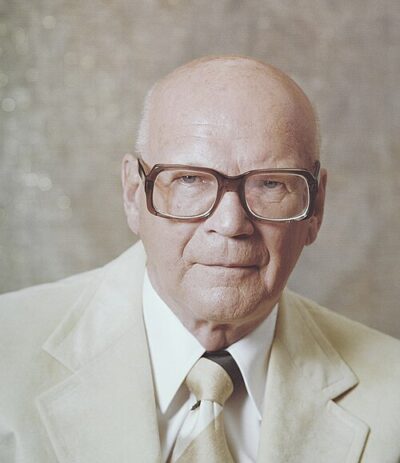
Urho Kekkonen
Urho Kekkonen was an eighth President of Finland. Born September 3, 1900, in Lepikon torppa. Died August 31, 1986, in Tamminiemi. Positions held include President of Finland (1956–1982), Prime Minister of Finland (1950–1956) and Minister of the Interior (2 times) (1937–1951). Educated at University of Helsinki. Awards include Commander of the Order of Sports Merit, Commander with Star of the Order of Merit of the Kingdom of Hungary and Commander First Class of the Order of the Lion of Finland.
Facts
56 facts · 2 confirmed by two sources · 21 cited · 33 from one source
Where this comes from
Papalocal keeps its own record. It started from these sources; what each one said is kept here as it was copied, so a change on their side never changes this page by itself. Tap one to read its version.
What Wikidata says · copied November 16, 2026 · revision 2565054449
- Described as
- eighth President of Finland (1900–1986)
- Other names
- Urho Kaleva Kekkonen, Kekkonen
- Born
- September 3, 1900 · 11 references
- Died
- August 31, 1986 · 10 references
- Born in
- Lepikon torppa · 1 reference
- Died in
- Tamminiemi · 1 reference
- Buried in
- Hietaniemi cemetery · 1 reference
- Name at birth
- Urho Kaleva Kekkonen
- Citizen of
- Finland (1917–); Grand Duchy of Finland (–1917)
- Occupation
- politician · 2 references; athletics competitor; lawyer; journalist; sprinter · 1 reference; police officer · 1 reference; foreign minister · 1 reference
- Positions held
- President of Finland (1956–1982); Prime Minister of Finland (1950–1956); Minister of the Interior (2 times) (1937–1951); Minister of Justice of Finland (2 times) (1936–1946); Minister for Foreign Affairs of Finland (1952–1953); Speaker of the Parliament of Finland (1948–1950); member of the Parliament of Finland (1936–1956); justice minister · 1 reference; interior minister · 1 reference
- Political party
- Centre Party (1933–) · 1 reference
- Education
- University of Helsinki
- Member of
- White Guard · 1 reference
- Sport
- athletics
- Awards
- Commander of the Order of Sports Merit (1933) · 1 reference; Commander with Star of the Order of Merit of the Kingdom of Hungary (1943) · 1 reference; Commander First Class of the Order of the Lion of Finland (1947) · 1 reference; The Great Cross of Merit of Finnish Sports and Culture of Physical Exercise (1950) · 1 reference; Queen Elizabeth II Coronation Medal (1952) · 1 reference; Finnish Olympic Cross of Merit, First Class (1952) · 1 reference; Grand Cross of the Order of the White Rose of Finland (1953) · 1 reference; Grand Cross of the Order of the Holy Lamb (1955) · 1 reference; Grand Cross of the Order of the Cross of Liberty (1956) · 1 reference; Grand Cross with Collar of the Order of the White Rose of Finland (1956) · 1 reference; Grand Cross of the Order of the Lion of Finland (1956) · 1 reference; Royal Order of the Seraphim (1956) · 1 reference; Grand Cross with Collar of the Order of the Falcon (1957) · 1 reference; Knight of the Order of the Elephant (1957) · 1 reference; Grand Cross of the Legion of Honour (1958) · 1 reference
- Spouse
- Sylvi Kekkonen (1926–1974) · 1 reference
- Children
- Taneli Kekkonen · 1 reference; Matti Kekkonen · 1 reference
- Father
- Juho Kekkonen · 1 reference
- Mother
- Emilia Kekkonen
- Siblings
- Jussi Kekkonen; Siiri Kekkonen
- Religion
- Lutheranism
- Lived in
- Pielavesi (1900–1906) · 1 reference; Kuopio (1906–) · 1 reference; Lapinlahti · 1 reference; Iisalmi (–1911) · 1 reference; Kajaani (1911–1921) · 1 reference
- Wikipedias with a page
- 76
Wikidata item Q179858 (wikidata.org/wiki/Q179858), public domain (CC0). Copied November 16, 2026.
What Wikipedia says · copied November 16, 2026 · revision 1384286096
Urho Kaleva Kekkonen (3 September 1900 – 31 August 1986), often referred to by his initials UKK, was a Finnish politician who served as the eighth and longest-serving president of Finland from 1956 to 1982. He also served as prime minister (1950–1953, 1954–1956), and held various other cabinet positions. He was the third and most recent president from the Agrarian League/Centre Party. Head of state for nearly 26 years, he dominated Finnish politics for 31 years overall. Holding a large amount of power, he won his later elections with little opposition and has often been classified as an autocrat.
As president, Kekkonen continued the "active neutrality" policy of his predecessor President Juho Kusti Paasikivi that came to be known as the Paasikivi–Kekkonen doctrine, under which Finland was to retain its independence while maintaining good relations and extensive trade with members of both NATO and the Warsaw Pact. Critical commentators referred to this policy of appeasement pejoratively as Finlandization. He is credited by Finnish historians for his foreign and trade policies, which allowed Finland's market economy to keep pace with Western Europe even with the Soviet Union as a neighbor, and for Finland to gradually take part in the European integration process. On the other hand, his perceived autocracy, divide-and-rule attitude in domestic politics and the lack of genuine political opposition, especially during the latter part of his presidency, significantly weakened Finnish democracy during his presidency. Kekkonen was nominated for the Nobel Peace Prize in 1962 for his "tireless efforts and success at keeping peace and security in the Nordic countries, and therefore contributing to civic peace and reconciliation in the World". He was also considered a potential candidate for the prize on later occasions.
Narrowly elected in the 1956 presidential election, Kekkonen consolidated power by successfully presenting himself as an indispensable "guarantor" of Soviet relations in a tense and politically unstable period. He was reelected in 1962 in the aftermath of the Note Crisis and the withdrawal of the main opposition candidate. Kekkonen typically favoured appointing "popular front" cabinets composed of centrist and left-wing parties trusted by the Soviet Union while leaving out the major right-wing National Coalition Party. He was elected to a third six-year term in 1968 and achieved the height of his power in the 1970s; in 1973, an emergency law extending his term by four years passed the Parliament with 170 votes for and only 28 against. In 1975, considered the peak year of his career, Kekkonen hosted the Conference on Security and Co-operation in Europe in Helsinki and resolved a domestic political crisis by pressuring party leaders into joining a new "popular front" cabinet in front of television cameras. He was elected to his fourth and final term by an overwhelming margin in 1978, but his health and mental faculties visibly deteriorated, forcing him to submit his resignation in late 1981 and retire. After Kekkonen's presidency, the reform of the Constitution of Finland was initiated by his successors to increase the power of the Parliament and the prime minister at the expense of the president and to introduce a term limit.
Kekkonen was a member of the Parliament of Finland from 1936 until his rise to the presidency. Either prior, during or between his premierships, he served as minister of justice (1936–37, 1944–46, 1951), minister of the interior (1937–39, 1950–51), speaker of the Finnish Parliament (1948–50) and minister of foreign affairs (1952–53, 1954). In addition to his extensive political career, he was a lawyer by education, a policeman and athlete in his youth, a veteran of the Finnish Civil War, and an enthusiastic writer. During World War II, his anonymous reports on the war and foreign politics received a large audience in the Suomen Kuvalehti magazine. Even during his presidency, he wrote humorous, informal columns (causerie) for the same magazine, edited by his long-time friend Ilmari Turja, under several pseudonyms.
- Born, in its opening lines
- September 3, 1900
- Died, in its opening lines
- August 31, 1986
From the Wikipedia article “Urho Kekkonen” (en.wikipedia.org/wiki/Urho_Kekkonen), by its contributors, under CC BY-SA 4.0 (creativecommons.org/licenses/by-sa/4.0/). Copied November 16, 2026; not changed.
Confirmed Two sources agree. Cited One source, and it names where it got it. One source One source, without a reference of its own. Sources disagree The sources disagree. We show the best-supported value and keep theirs below.
