
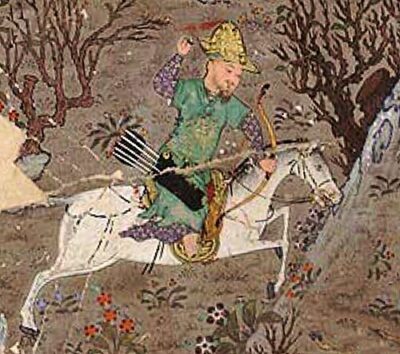
Uzun Hassan
Uzun Hassan was a greatest shah of the Turkoman Aq Qoyunlu dynasty (r. 1453–1478). Born 1423, in Diyarbakır. Died January 6, 1478, in Tabriz. Positions held include king.
Facts
20 facts · 0 confirmed by two sources · 0 cited · 18 from one source · 2 where the sources disagree
What’s different
- Born: we show 1423 (Sources disagree). Wikipedia says March 1425
- Died: we show January 6, 1478 (Sources disagree). Wikipedia says January 5, 1478
Where this comes from
Papalocal keeps its own record. It started from these sources; what each one said is kept here as it was copied, so a change on their side never changes this page by itself. Tap one to read its version.
What Wikidata says · copied November 16, 2026 · revision 2553928886
- Described as
- greatest shah of the Turkoman Aq Qoyunlu dynasty (r. 1453–1478)
- Other names
- Uzun Hasan Ali Abu 'I-Nasr, Uzun Hasan
- Born
- 1423
- Died
- January 6, 1478
- Born in
- Diyarbakır
- Died in
- Tabriz
- Citizen of
- Aq Qoyunlu
- Occupation
- sovereign
- Positions held
- king
- Spouse
- Despina Khatun (1458–) · 1 reference; Selçukşah Begum
- Children
- Yaqub Beg; Halima Begum; Sultan-Khalil; Maqsud Mirza · 1 reference; Uğurlu Mehmet Bey · 1 reference; Zeynel Bey; Yusif Mirzə (Ağqoyunlu) · 1 reference
- Father
- Ali bin Qara Yoluq Osman · 1 reference
- Mother
- Sara Khatun
- Siblings
- Khadijeh Begum
- Religion
- Sunni Islam
- Wikipedias with a page
- 41
Wikidata item Q374468 (wikidata.org/wiki/Q374468), public domain (CC0). Copied November 16, 2026.
What Wikipedia says · copied November 16, 2026 · revision 1381560780
Uzun Hasan or Uzun Hassan (Persian: اوزون حسن; February or March 1425 – January 5, 1478) was a ruler of the Turkoman Aq Qoyunlu state and is generally considered to be its strongest ruler. Hasan was from the Bayandur tribe and presided over the confederation's territorial apex, when it included parts or all of present-day Iraq, Turkey, Azerbaijan, Iran, Transcaucasia, and Syria.
The younger son of Ali Beg and Sara Khatun, Hasan rose to prominence during the protracted Aq Qoyunlu civil war of the 1440s and 1450s. He seized the confederate capital of Amid from his brother Jahangir in a bloodless coup in September 1452, and became undisputed ruler after defeating Jahangir and his Qara Qoyunlu allies at the Battle on the Tigris in May 1457. Over the following decade he secured his frontiers against the Ayyubids of Hisn Kayfa, the Kurdish principalities of Diyar Bakr, the Dulkadirids and the Karamanids, while conducting raids into Georgia that won him a reputation as a ghazi.
Hasan destroyed the Qara Qoyunlu at the Battle of Muş on November 10, 1467, killing their ruler Jahan Shah, and captured and executed the Timurid sultan Abu Sa'id Mirza in Qarabagh two years later. These victories brought western and central Iran, Fars, Kerman and Arab Iraq under his rule and transformed the Aq Qoyunlu from a regional principality into an empire, with its capital transferred from Amid to Tabriz. Allied with the Venetian Republic against the Ottomans, he invaded Anatolia and Mamluk Syria in 1472 but was decisively defeated by Mehmed II at Otlukbeli on August 11, 1473, a reverse that Woods regards as having ended Aq Qoyunlu expansion and damaged the religious claims underpinning Hasan's authority. His last years were consumed by the rebellion of his son Ughurlu Muhammad and by declining health. He died near Tabriz in January 1478.
Hasan is remembered chiefly for his attempt to convert a nomadic tribal confederation into a settled Perso-Islamic empire. He expanded the central bureaucracy, recruited Iranian administrative families, promulgated a body of commercial, civil, penal and fiscal law known as the qanun-namas, and cultivated the religious establishment and the Sufi orders, including the Safavid order, into which he married both a sister and a daughter. His grandson Ismail I founded the Safavid state in 1501.
- Born, in its opening lines
- March 1425
- Died, in its opening lines
- January 5, 1478
From the Wikipedia article “Uzun Hasan” (en.wikipedia.org/wiki/Uzun_Hasan), by its contributors, under CC BY-SA 4.0 (creativecommons.org/licenses/by-sa/4.0/). Copied November 16, 2026; not changed.
Confirmed Two sources agree. Cited One source, and it names where it got it. One source One source, without a reference of its own. Sources disagree The sources disagree. We show the best-supported value and keep theirs below.
