
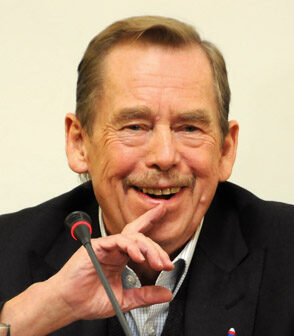
Václav Havel
Václav Havel was a Czech statesman, playwright, and former dissident, the last president of Czechoslovakia and the first president of the Czech Republic. Born October 5, 1936, in Prague. Died December 18, 2011, in Hrádeček. Positions held include President of Czechoslovakia (1989–1992), President of the Czech Republic (1993–2003) and spokesperson of Charter 77. Known for Antikódy, The Garden Party and Leaving. Educated at Czech Technical University in Prague and Faculty of Theatre, Academy of Performing Arts in Prague. Awards include Charlemagne Prize, Grand Cross of the Legion of Honour and Collar of the Order of the White Lion.
Facts
76 facts · 2 confirmed by two sources · 27 cited · 47 from one source
Where this comes from
Papalocal keeps its own record. It started from these sources; what each one said is kept here as it was copied, so a change on their side never changes this page by itself. Tap one to read its version.
What Wikidata says · copied November 16, 2026 · revision 2564307797
- Described as
- Czech statesman, playwright, and former dissident, the last president of Czechoslovakia and the first president of the Czech Republic (1936–2011)
- Other names
- Vaclav Havel
- Born
- October 5, 1936 · 10 references
- Died
- December 18, 2011 · 13 references
- Born in
- Prague · 7 references
- Died in
- Hrádeček · 1 reference
- Buried in
- Vinohrady Cemetery (2012–) · 2 references
- Cause of death
- respiratory failure
- Citizen of
- Czechoslovakia; Czech Republic
- Occupation
- writer · 2 references; playwright · 2 references; politician · 2 references; director; poet; film director · 1 reference; human rights defender; dissident
- Positions held
- President of Czechoslovakia (1989–1992); President of the Czech Republic (1993–2003); spokesperson of Charter 77
- Political party
- Civic Forum (1989–1991)
- Worked for
- Divadlo Na zábradlí (1960–1968) · 1 reference; City Theatres of Prague; Brewery Krakonoš (1974) · 1 reference; University of Chemistry and Technology (1951–1955) · 1 reference; Osvobozené divadlo; Divadlo U Nováků; Divadlo ABC; Divadlo satiry
- Education
- Czech Technical University in Prague (1955–1957) · 1 reference; Faculty of Theatre, Academy of Performing Arts in Prague; Akademické gymnázium Štěpánská (–1955) · 1 reference
- Member of
- Czech Helsinki Comitee; Committee for the Defense of the Unjustly Prosecuted; German Academy for Language and Literature; Royal Society of Literature; American Academy of Arts and Sciences; Bavarian Academy of Fine Arts; Club of Rome; Junák; Charter 77 · 1 reference
- Known for
- Antikódy; The Garden Party; Leaving; The Power of the Powerless; The Memorandum; Audience; Temptation; Largo desolato
- Awards
- Charlemagne Prize (1991) · 1 reference; Grand Cross of the Legion of Honour (1990); Collar of the Order of the White Lion (2003); Order of Tomáš Garrigue Masaryk, 1st class (2003); Presidential Medal of Freedom (2003) · 1 reference; Grand Cross of the Order of the White Double Cross (2003) · 1 reference; Grand Cross of the Order of Vytautas the Great (1999); Collar of the Order of the Cross of Terra Mariana (1996) · 1 reference; Order of the White Eagle (1993); Commandeur des Arts et des Lettres (2001); Gottlieb Duttweiler Prize (1990); Austrian Decoration for Science and Art (2005); Grand Collar of the Order of the Southern Cross (1990); Honorary Knight Grand Cross of the Order of the Bath (1996) · 1 reference; Collar of the Order of Isabella the Catholic (1995) · 1 reference
- Field
- theatre · 1 reference; drama · 1 reference; opinion journalism · 1 reference; politics · 2 references
- Spouse
- Olga Havlová (1964–1996) · 1 reference; Dagmar Havlová (1997–2011) · 2 references
- Father
- Václav M. Havel · 1 reference
- Mother
- Božena Vavrečková · 1 reference
- Siblings
- Ivan M. Havel · 1 reference
- Religion
- lapsed Catholic
- Lived in
- U dejvického rybníčku (1977) · 1 reference; Rašínovo nábřeží 78 (2 times) (1936–1993) · 1 reference
- Website
- https://www.vaclavhavel.cz
- Wikipedias with a page
- 145
Wikidata item Q36233 (wikidata.org/wiki/Q36233), public domain (CC0). Copied November 16, 2026.
What Wikipedia says · copied November 16, 2026 · revision 1385458800
Václav Havel (Czech: [ˈvaːt͡slav ˈɦavɛl] ; 5 October 1936 – 18 December 2011) was a Czech statesman, author, poet, playwright, and dissident. Havel served as the last president of Czechoslovakia from 1989 until 1992, prior to the dissolution of Czechoslovakia on 31 December, before he became the first president of the Czech Republic from 1993 to 2003. He was the first democratically elected president of either country after the fall of communism. As a writer of Czech literature, he is known for his plays, essays and memoirs.
His educational opportunities having been limited by his bourgeois background under the Czechoslovak Socialist Republic, Havel first rose to prominence as a playwright. In works such as The Garden Party and The Memorandum, Havel used an absurdist style to criticize the Communist system. After participating in the Prague Spring and being blacklisted after the Warsaw Pact invasion of Czechoslovakia, he became more politically active and helped found several dissident initiatives, including Charter 77 and the Committee for the Defense of the Unjustly Prosecuted. His political activities brought him under the surveillance of the StB secret police, and he spent several periods as a political prisoner, the longest of his imprisoned terms being nearly four years, between 1979 and 1983.
Havel's Civic Forum party played a major role in the Velvet Revolution that toppled the Communist system in Czechoslovakia in 1989. He assumed the presidency shortly thereafter, and was re-elected in a landslide the following year and after Slovak independence in 1993. Havel was instrumental in dismantling the Warsaw Pact and enlargement of NATO membership eastward. Many of his stances and policies were controversial domestically, such as his opposition to Slovak independence, condemnation of the treatment of Sudeten Germans and their mass expulsion from Czechoslovakia after World War II, and granting of general amnesty to all those imprisoned under the Communist era. By the end of his presidency, he enjoyed greater popularity abroad than at home. Havel continued his life as a public intellectual after his presidency, launching several initiatives including the Prague Declaration on European Conscience and Communism, the VIZE 97 Foundation, and the Forum 2000 annual conference.
Havel's political philosophy was one of anti-consumerism, humanitarianism, environmentalism, civil activism, and direct democracy. He supported the Czech Green Party from 2004 until his death. He received numerous accolades during his lifetime, including the Presidential Medal of Freedom, the Gandhi Peace Prize, the Philadelphia Liberty Medal, the Order of Canada, the Four Freedoms Award, the Ambassador of Conscience Award, and the Hanno R. Ellenbogen Citizenship Award. The 2012–2013 academic year at the College of Europe was named in his honour. He is considered by some to be one of the most important intellectuals of the 20th century. The international airport in Prague was renamed Václav Havel Airport Prague in 2012.
- Born, in its opening lines
- October 5, 1936
- Died, in its opening lines
- December 18, 2011
From the Wikipedia article “Václav Havel” (en.wikipedia.org/wiki/Václav_Havel), by its contributors, under CC BY-SA 4.0 (creativecommons.org/licenses/by-sa/4.0/). Copied November 16, 2026; not changed.
Confirmed Two sources agree. Cited One source, and it names where it got it. One source One source, without a reference of its own. Sources disagree The sources disagree. We show the best-supported value and keep theirs below.
