
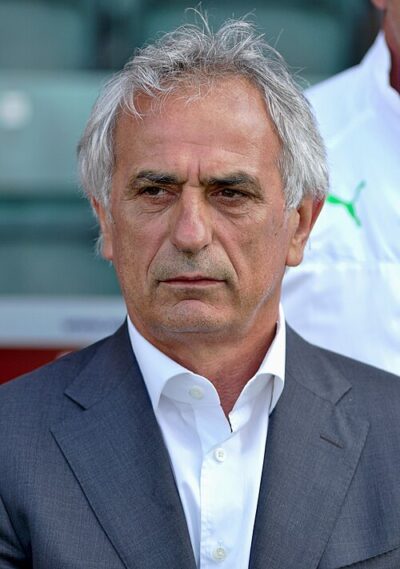
Vahid Halilhodžić
Vahid Halilhodžić is a Bosnian association football player and manager. Born October 15, 1952, in Jablanica. Teams include NK Neretva (1971–1972), FC Nantes (1981–1986) and FK Velež Mostar (1971–1981). Awards include Knight of the Legion of Honour.
Facts
17 facts · 1 confirmed by two sources · 4 cited · 12 from one source
Where this comes from
Papalocal keeps its own record. It started from these sources; what each one said is kept here as it was copied, so a change on their side never changes this page by itself. Tap one to read its version.
What Wikidata says · copied November 16, 2026 · revision 2556491695
- Described as
- Bosnian association football player and manager (born 1952)
- Other names
- Vahid Halilhodzic
- Born
- October 15, 1952 · 1 reference
- Born in
- Jablanica
- Citizen of
- Bosnia and Herzegovina; France (1997–) · 1 reference
- Occupation
- association football player · 1 reference; association football coach · 1 reference
- Teams
- NK Neretva (1971–1972); FC Nantes (1981–1986); FK Velež Mostar (1971–1981); Paris Saint-Germain FC (1986–1987); Yugoslavia men's national football team (1976–1985); Yugoslavia national under-21 football team (1975–1978); FK Turbina Jablanica (–1968) · 1 reference
- Sport
- association football · 1 reference
- Awards
- Knight of the Legion of Honour (2004) · 1 reference
- Religion
- Islam
- Height
- 1.82 m (6 ft 0 in)
- Wikipedias with a page
- 52
Wikidata item Q463933 (wikidata.org/wiki/Q463933), public domain (CC0). Copied November 16, 2026.
What Wikipedia says · copied November 16, 2026 · revision 1381788518
Vahid Halilhodžić (Bosnian pronunciation: [ʋȃ:xid xǎlilxodʒitɕ]; born 15 October 1952) is a Bosnian former professional football manager and former player. He is regarded as one of the most controversially successful Bosnian football managers, due to his successful tenure in coaching various national teams yet having problematic relations with his teams and players due to different approaches.
Regarded as one of the best Yugoslav players, Halilhodžić had successful playing spells with Velež Mostar and French clubs Nantes and Paris Saint-Germain before retiring in 1987. During that time, he earned 15 full international caps for Yugoslavia and was part of national squads who won the 1978 European Under-21 Championship and played at the 1982 FIFA World Cup. He was top scorer of the French league in 1983 and 1985.
In the early 1990s, Halilhodžić turned to coaching and, after a short stint as a sporting director at Velež, permanently moved to France in 1993 after fleeing war-torn Bosnia with his family. Since then, he managed a number of teams in French-speaking countries and his achievements include winning the 1997 CAF Champions League with Moroccan side Raja Casablanca, leading French side Lille from second level to third place in Ligue 1 in less than three years, winning the 2003–04 Coupe de France with Paris Saint-Germain, and winning the Croatian league in 2011 with Dinamo Zagreb.
Halilhodžić also qualified for the 2010 World Cup with Ivory Coast (although he was sacked only months before the final tournament) and the 2014 World Cup with Algeria, with whom he reached the round of 16, Algeria's best result in history. Later, he qualified for the 2018 World Cup with Japan, but again was fired just prior to the tournament. After a short stint with Nantes in 2018, where he helped avoid relegation to Ligue 2, Halilhodžić became head coach of the Morocco national team, whom he qualified for the 2022 World Cup. Like with Ivory Coast and Japan, he was sacked by the Royal Moroccan Football Federation in August 2022, after Morocco's poor performance at the 2021 Africa Cup of Nations and his fallout with star player Hakim Ziyech.
- Born, in its opening lines
- October 15, 1952
From the Wikipedia article “Vahid Halilhodžić” (en.wikipedia.org/wiki/Vahid_Halilhodžić), by its contributors, under CC BY-SA 4.0 (creativecommons.org/licenses/by-sa/4.0/). Copied November 16, 2026; not changed.
Confirmed Two sources agree. Cited One source, and it names where it got it. One source One source, without a reference of its own. Sources disagree The sources disagree. We show the best-supported value and keep theirs below.
