
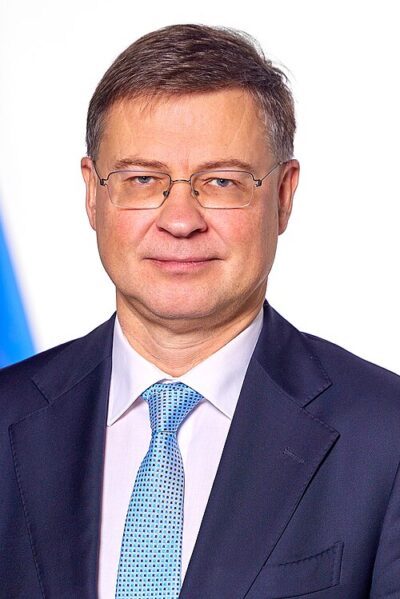
Valdis Dombrovskis
Valdis Dombrovskis is the 11th Prime Minister of Latvia. Born August 5, 1971, in Riga. Positions held include Prime Minister of Latvia (2009–2014), Member of the European Parliament (2 times) (2004–2014) and deputy of Saeima (2 times) (2010–2014). Educated at University of Latvia and Riga Technical University. Awards include Order of the Three Stars, 2nd Class, Commander First Class of the Order of the White Rose of Finland and Order of Prince Yaroslav the Wise, 1st class.
Facts
31 facts · 1 confirmed by two sources · 13 cited · 17 from one source
Where this comes from
Papalocal keeps its own record. It started from these sources; what each one said is kept here as it was copied, so a change on their side never changes this page by itself. Tap one to read its version.
What Wikidata says · copied November 16, 2026 · revision 2569175232
- Described as
- 11th Prime Minister of Latvia
- Born
- August 5, 1971 · 2 references
- Born in
- Riga · 2 references
- Citizen of
- Latvia
- Occupation
- politician · 2 references; economist; physicist · 1 reference; head of government · 1 reference
- Positions held
- Prime Minister of Latvia (2009–2014); Member of the European Parliament (2 times) (2004–2014); deputy of Saeima (2 times) (2010–2014) · 1 reference; European Commissioner for Trade (2020–2024) · 1 reference; European Commissioner for Internal Market (2016–2020) · 1 reference; Minister of Finance (2002–2004) · 1 reference; European Commissioner for Economic Affairs (2014–) · 2 references; vice-president of the European Commission (2014–2024) · 1 reference; European Commissioner for Economy (2024–); European Commissioner for Financial Stability, Financial Services and Capital Markets Union (2016–2020)
- Political party
- Unity (2011–) · 2 references; New Era Party (2002–2011) · 3 references
- Worked for
- University of Latvia
- Education
- University of Latvia; Riga Technical University (1989–1995) · 1 reference; Johannes Gutenberg University Mainz; University of Maryland
- Awards
- Order of the Three Stars, 2nd Class; Commander First Class of the Order of the White Rose of Finland (2013) · 1 reference; Order of Prince Yaroslav the Wise, 1st class · 1 reference; Order of Prince Yaroslav the Wise, 2nd class · 1 reference; Order of the Cross of Terra Mariana, 1st Class (2012) · 1 reference
- Spouse
- Ārija Dombrovska
- Website
- http://valdisdombrovskis.lv · 1 reference
- Wikipedias with a page
- 57
Wikidata item Q57630 (wikidata.org/wiki/Q57630), public domain (CC0). Copied November 16, 2026.
What Wikipedia says · copied November 16, 2026 · revision 1378125138
Valdis Dombrovskis (born 5 August 1971) is a Latvian politician serving as European Commissioner for Economy and Productivity, and Commissioner for Implementation and Simplification. He previously served as Executive Vice President of the European Commission for An Economy that Works for People (2019-2024), European Commissioner for Trade (2020-2024). European Commissioner for Financial Stability, Financial Services and Capital Markets Union (2016-2020) and Prime Minister of Latvia from 2009 to 2014.
Dombrovskis served as Minister for Finance of Latvia from 2002 to 2004. He then served as a Member of the European Parliament (MEP) for the New Era Party from 2004 to 2009. He became the Prime Minister of Latvia in 2009, serving until his resignation in 2014. He was Vice-President of the European Commission for the Euro and Social Dialogue from 2014 to 2019. Following the resignation of Lord Jonathan Hill, Dombrovskis served as European Commissioner for Financial Stability, Financial Services and the Capital Markets Union from 2016 to 2020. Following the resignation of Phil Hogan, it was announced that he would take over the portfolio for Trade.
- Born, in its opening lines
- August 5, 1971
From the Wikipedia article “Valdis Dombrovskis” (en.wikipedia.org/wiki/Valdis_Dombrovskis), by its contributors, under CC BY-SA 4.0 (creativecommons.org/licenses/by-sa/4.0/). Copied November 16, 2026; not changed.
Confirmed Two sources agree. Cited One source, and it names where it got it. One source One source, without a reference of its own. Sources disagree The sources disagree. We show the best-supported value and keep theirs below.
