
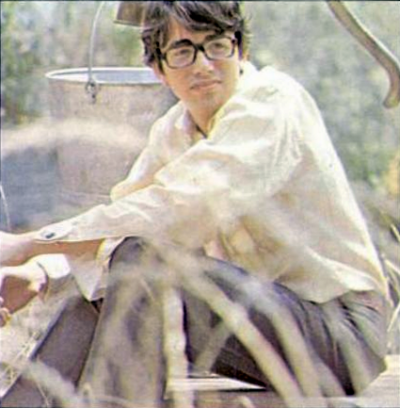
Van Dyke Parks
Van Dyke Parks is an American musician, songwriter, arranger, and record producer. Born January 3, 1941, in Hattiesburg. Educated at McKeesport Area High School.
Facts
17 facts · 0 confirmed by two sources · 3 cited · 13 from one source · 1 where the sources disagree
What’s different
- Born: we show January 3, 1941 (Sources disagree). Wikipedia says January 3, 1943
Where this comes from
Papalocal keeps its own record. It started from these sources; what each one said is kept here as it was copied, so a change on their side never changes this page by itself. Tap one to read its version.
What Wikidata says · copied November 16, 2026 · revision 2567565973
- Described as
- American musician, songwriter, arranger, and record producer (born 1943)
- Born
- January 3, 1941 · 3 references
- Born in
- Hattiesburg · 1 reference
- Citizen of
- United States
- Occupation
- actor; composer · 1 reference; songwriter; record producer; film score composer; singer-songwriter; pianist · 1 reference; conductor · 1 reference
- Education
- McKeesport Area High School · 1 reference
- Member of
- American Society of Composers, Authors and Publishers
- Genre
- pop music
- Instrument
- guitar
- Record label
- Warner Bros. Records
- Website
- http://www.vandykeparks.com/
- Wikipedias with a page
- 20
Wikidata item Q339031 (wikidata.org/wiki/Q339031), public domain (CC0). Copied November 16, 2026.
What Wikipedia says · copied November 16, 2026 · revision 1385389036
Van Dyke Parks (born January 3, 1943) is an American musician, songwriter, arranger, record producer, and former Warner Bros. Records executive whose work encompasses orchestral pop, elaborate recording experiments, Americana iconography, free-associative lyrics, and Caribbean sounds. He is best known for his 1967 album Song Cycle and his collaborative work with acts such as the Beach Boys, Lowell George, Joanna Newsom, and Harry Nilsson.
Born in Hattiesburg, Mississippi, Parks toured nationally with the American Boychoir School in Princeton, New Jersey and concurrently pursued child acting roles in television and theater productions. After relocating to California in 1963, he performed folk music with his brother Carson along the West Coast and contributed arrangements to Disney film soundtracks, including "The Bare Necessities" for The Jungle Book (1967). By the mid-1960s, he was an active session musician in Laurel Canyon, working with artists such as Tim Buckley, Judy Collins, and the Byrds before collaborating with Brian Wilson on the Beach Boys' Smile, later completed in 2004 as Wilson's solo album.
In 1966, Parks joined Warner Bros. and formed part of a creative circle at the label through producer Lenny Waronker, with whom he collaborated on albums by Harpers Bizarre, Randy Newman, Arlo Guthrie, and Ry Cooder. By the early 1970s, Parks had transitioned to an executive role at Warner Bros., where he spearheaded the first ever label division centered on promotional films for artists. Influenced by the 1969 Santa Barbara oil spill, he concurrently pursued calypso and steel pan music in projects such as his album Discover America (1971), productions for Mighty Sparrow and the Esso Trinidad Steel Band, and Nilsson's mid-1970s recordings.
After the late 1970s, Parks focused on composing for film and television, contributing to works including Popeye (with Nilsson, 1980), Follow That Bird (1985), and The Brave Little Toaster (1987). He authored a trilogy of children's books based on his 1984 album Jump!, a musical adaptation of Br'er Rabbit folktales. He has remained active as a collaborator and arranger, working with artists such as Rufus Wainwright, Silverchair, and Joanna Newsom, while releasing three additional studio albums: Tokyo Rose (1989), Orange Crate Art (with Wilson, 1995), and Songs Cycled (2013).
- Born, in its opening lines
- January 3, 1943
From the Wikipedia article “Van Dyke Parks” (en.wikipedia.org/wiki/Van_Dyke_Parks), by its contributors, under CC BY-SA 4.0 (creativecommons.org/licenses/by-sa/4.0/). Copied November 16, 2026; not changed.
Confirmed Two sources agree. Cited One source, and it names where it got it. One source One source, without a reference of its own. Sources disagree The sources disagree. We show the best-supported value and keep theirs below.
