
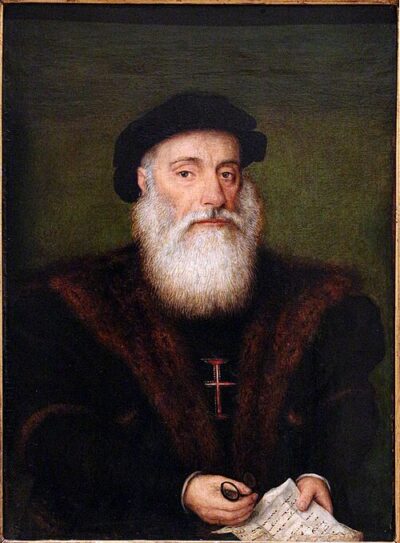
Vasco da Gama
Vasco da Gama was a Portuguese explorer (c. 1460s – 1524). Born 1469, in Sines. Died December 24, 1524, in Kochi. Positions held include Viceroy of the Portuguese Provinces of India (1524).
Facts
24 facts · 0 confirmed by two sources · 10 cited · 13 from one source · 1 where the sources disagree
What’s different
- Born: we show 1469 (Sources disagree). Wikidata also lists 1460
Where this comes from
Papalocal keeps its own record. It started from these sources; what each one said is kept here as it was copied, so a change on their side never changes this page by itself. Tap one to read its version.
What Wikidata says · copied November 16, 2026 · revision 2568005248
- Described as
- Portuguese explorer (c. 1460s – 1524)
- Other names
- Count of Vidigueira
- Born
- 1469 · 1 reference; 1460 · 1 reference
- Died
- December 24, 1524 · 1 reference
- Born in
- Sines · 1 reference
- Died in
- Kochi · 1 reference
- Buried in
- Jerónimos Monastery
- Cause of death
- malaria
- Citizen of
- Kingdom of Portugal · 1 reference
- Occupation
- explorer; world traveler · 1 reference; seafarer · 2 references; naval officer; discoverer · 1 reference
- Positions held
- Viceroy of the Portuguese Provinces of India (1524)
- Spouse
- Catarina de Ataíde · 1 reference
- Children
- Estêvão da Gama; Cristóvão da Gama; Estêvão da Gama · 1 reference; Francisco da Gama · 1 reference; Álvaro de Ataíde da Gama; Francisco da Gama, 2nd Conde de Vidigueira, Admiral of India · 1 reference
- Father
- Estêvão da Gama
- Mother
- Izabel Sodre · 1 reference
- Siblings
- Paulo da Gama · 1 reference
- Military rank
- admiral
- Wikipedias with a page
- 184
Wikidata item Q7328 (wikidata.org/wiki/Q7328), public domain (CC0). Copied November 16, 2026.
What Wikipedia says · copied November 16, 2026 · revision 1379526737
Vasco da Gama ( VAS-koo də GA(H)M-ə, European Portuguese: [ˈvaʃku ðɐ ˈɣɐmɐ]; c. 1460s – 24 December 1524) was a Portuguese mariner, explorer and nobleman. His discovery of the first maritime route between Europe and India—around the Cape of Good Hope, then across the Indian Ocean from Malindi in Kenya to Kozhikode—opened up European exploration of, and commerce with, India, and is considered a landmark event in world history.
Da Gama's first voyage (1497–1499) was the first to link Europe and Asia using an ocean route that rounded the southern tip of Africa, although he was not the first Portuguese mariner to round the Cape. This route allowed the Portuguese to avoid sailing across the disputed Mediterranean Sea and to trade with Eastern Arab Mediterranean ports that embarked goods from land routes across the dangerous Arabian Peninsula. A milestone in Portuguese maritime exploration, his voyage marked the beginning of a sea-based phase of international eastern trade and an age of global imperialism. His outward and return voyages constituted the longest known ocean voyages ever completed at the time. The Portuguese later established a long-lasting colonial empire along the route from Africa to Asia at the expense of the existing Arab eastern trade network.
Sailors had been trying to reach the Indies for decades, with thousands of lives and dozens of vessels lost in shipwrecks and attacks. Da Gama finally accomplished the feat when he landed at Kozhikode on 20 May 1498. Unchallenged access to the Indian spice routes boosted the economy of the Portuguese Empire, which was previously based along North and coastal West Africa. The main spices first obtained from Southeast Asia were pepper and cinnamon, but other commodities new to Europe were soon included in trade. Portugal maintained a commercial monopoly of these commodities for several decades. It was not until a century later that other European powers were able to challenge Portugal's monopoly and naval supremacy in the Cape Route.
Da Gama led two of the Portuguese India Armadas, the first and the fourth. The latter was the largest, and departed for India three years after his return from the first. As reward for his accomplishments, da Gama was appointed Governor of India in 1524, with the title of Viceroy, and was ennobled the Count of Vidigueira in 1519. He remains a leading figure in the history of exploration; homages worldwide have celebrated his explorations and accomplishments. The Portuguese national epic poem, Os Lusíadas, was written in his honor by Luís de Camões.
From the Wikipedia article “Vasco da Gama” (en.wikipedia.org/wiki/Vasco_da_Gama), by its contributors, under CC BY-SA 4.0 (creativecommons.org/licenses/by-sa/4.0/). Copied November 16, 2026; not changed.
Confirmed Two sources agree. Cited One source, and it names where it got it. One source One source, without a reference of its own. Sources disagree The sources disagree. We show the best-supported value and keep theirs below.
