
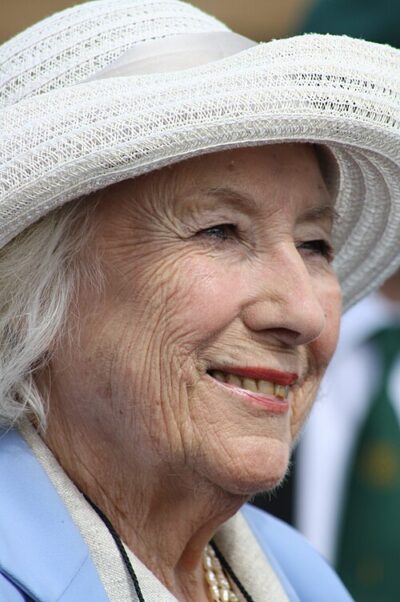
Vera Lynn
Vera Lynn was a British singer. Born March 20, 1917, in East Ham. Died June 18, 2020, in Princess Royal Hospital. Educated at Brampton Primary School. Awards include Dame Commander of the Order of the British Empire, War Medal 1939–1945 and Burma Star.
Facts
33 facts · 2 confirmed by two sources · 10 cited · 21 from one source
Where this comes from
Papalocal keeps its own record. It started from these sources; what each one said is kept here as it was copied, so a change on their side never changes this page by itself. Tap one to read its version.
What Wikidata says · copied November 16, 2026 · revision 2562638168
- Described as
- British singer (1917–2020)
- Other names
- Dame Vera Lynn, Dame Vera Margaret Lynn, Vera Margaret Welch
- Born
- March 20, 1917 · 5 references
- Died
- June 18, 2020 · 3 references
- Born in
- East Ham
- Died in
- Princess Royal Hospital
- Buried in
- The Parish Church of St Margaret, Ditchling
- Name at birth
- Vera Margaret Welch
- Citizen of
- United Kingdom · 1 reference
- Occupation
- film actor · 3 references; singer · 1 reference; singer-songwriter; autobiographer · 1 reference; recording artist; actor · 1 reference; lyricist · 1 reference; musician · 1 reference
- Education
- Brampton Primary School
- Genre
- popular music · 1 reference
- Instrument
- voice
- Record label
- EMI; His Master's Voice; Decca; London Records
- Awards
- Dame Commander of the Order of the British Empire; War Medal 1939–1945; Burma Star; Officer of the Order of Saint John (1997); Companion of Honour (2016); Commander of the Order of Orange-Nassau (1977); Classic Brit Awards
- Field
- music composing; pop music · 1 reference; acting · 1 reference; popular music · 1 reference
- Wikipedias with a page
- 55
Wikidata item Q229330 (wikidata.org/wiki/Q229330), public domain (CC0). Copied November 16, 2026.
What Wikipedia says · copied November 16, 2026 · revision 1385729325
Dame Vera Margaret Lewis (née Welch; 20 March 1917 – 18 June 2020), known professionally as Vera Lynn, was an English singer and entertainer whose musical recordings and performances were popular during World War II. She is honorifically known as the "Forces' Sweetheart", having given outdoor concerts for the troops in Egypt, India, and Burma during the war as part of the Entertainments National Service Association. The Oxford Dictionary of National Biography wrote of Lynn, "Her reassuring voice and mastery of radio made her the forces' sweetheart in the Second World War—a connection she fostered with her ongoing commitment to veterans and memory of the war." The songs most associated with her include "We'll Meet Again", "(There'll Be Bluebirds Over) The White Cliffs of Dover" and "A Nightingale Sang in Berkeley Square".
Lynn remained popular after the war, appearing on radio and television in the United Kingdom and the United States and recording such hits as "Auf Wiederseh'n, Sweetheart" and her UK number-one single "My Son, My Son". In 2009, at the age of 92, she became the oldest living artist to top the UK Albums Chart with the compilation album We'll Meet Again: The Very Best of Vera Lynn. In 2017, Decca Records released Vera Lynn 100, a collection of younger artists duetting with archive recordings by Lynn. Issued to commemorate her centenary, it was a No. 3 hit, making her the first centenarian performer to have a Top 10 album in the charts. By the time of her death in 2020, she had been active in the music industry for 96 years.
She devoted much time and energy to charity work connected with ex-servicemen, disabled children, and breast cancer. She was held in great affection by Second World War veterans, and in 2000 was named the Briton who best exemplified the spirit of the 20th century.
- Born, in its opening lines
- March 20, 1917
- Died, in its opening lines
- June 18, 2020
From the Wikipedia article “Vera Lynn” (en.wikipedia.org/wiki/Vera_Lynn), by its contributors, under CC BY-SA 4.0 (creativecommons.org/licenses/by-sa/4.0/). Copied November 16, 2026; not changed.
Confirmed Two sources agree. Cited One source, and it names where it got it. One source One source, without a reference of its own. Sources disagree The sources disagree. We show the best-supported value and keep theirs below.
