
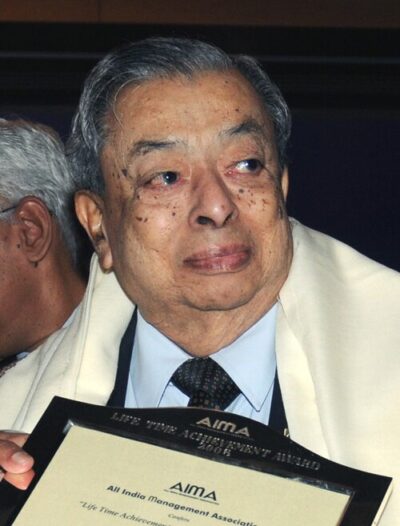
Verghese Kurien
Verghese Kurien was an Indian entrepreneur. Born November 26, 1921, in Kozhikode. Died September 9, 2012, in Nadiad. Educated at Loyola College and University of Madras. Awards include Ramon Magsaysay Award, Padma Bhushan in Trade & Industry and World Food Prize.
Facts
22 facts · 2 confirmed by two sources · 0 cited · 20 from one source
Where this comes from
Papalocal keeps its own record. It started from these sources; what each one said is kept here as it was copied, so a change on their side never changes this page by itself. Tap one to read its version.
What Wikidata says · copied November 16, 2026 · revision 2569504256
- Described as
- Indian entrepreneur
- Born
- November 26, 1921 · 1 reference
- Died
- September 9, 2012 · 2 references
- Born in
- Kozhikode
- Died in
- Nadiad
- Cause of death
- kidney failure
- Citizen of
- British Raj (–1947); India (1950–); Dominion of India (1947–1950)
- Occupation
- engineer; entrepreneur; screenwriter; mechanical engineer · 1 reference
- Education
- Loyola College; University of Madras; Michigan State University; Diamond Jubilee Higher Secondary School
- Awards
- Ramon Magsaysay Award (1963); Padma Bhushan in Trade & Industry (1966); World Food Prize (1989); Wateler Peace Prize (1986); Padma Vibhushan in Science & Engineering (1999); Padma Shri in Trade & Industry (1965)
- Wikipedias with a page
- 31
Wikidata item Q180385 (wikidata.org/wiki/Q180385), public domain (CC0). Copied November 16, 2026.
What Wikipedia says · copied November 16, 2026 · revision 1380540886
Verghese Kurien (26 November 1921 – 9 September 2012) was an Indian dairy engineer and social entrepreneur. He led initiatives that contributed to the extensive increase in milk production in India termed as the White Revolution.
Kurien graduated in physics from the University of Madras in 1940 and received his masters in mechanical engineering from the Michigan State University in 1947. In 1949, Kurien was sent by the Government of India to run its experimental creamery at Anand, where he set up the Kaira District Cooperative Milk Producers' Union in 1950 which later became Amul. Amul organised the dairy farmers in the villages as a part of cooperatives and linked them to the milk consumers directly, eliminating the need for middlemen.
In 1965, Kurien was appointed as the head of the newly formed National Dairy Development Board (NDDB), which helped to set up similar cooperatives across India and made dairy farming one of the largest self-sustaining industries and employment generators in rural areas. The dairy cooperatives were successful in increasing the milk production as the dairy farmers controlled the procurement, processing, and marketing as the owners of the cooperative. This led to a multi-fold increase in milk output over the next few decades and helped India become the world's largest milk producer in 1998. The co-operative model was later applied to other agricultural industries in India such as the production of edible oils and replicated in other countries.
For his contributions in increasing the dairy output, Kurien is known as the "Father of the White Revolution" in India. He was awarded the Ramon Magsaysay Award in 1964 and the World Food Prize in 1989. In 1999, he received the Padma Vibhushan, India's second highest civilian honour. He was conferred the Order of Agricultural Merit by the French Government in 1997.
- Born, in its opening lines
- November 26, 1921
- Died, in its opening lines
- September 9, 2012
From the Wikipedia article “Verghese Kurien” (en.wikipedia.org/wiki/Verghese_Kurien), by its contributors, under CC BY-SA 4.0 (creativecommons.org/licenses/by-sa/4.0/). Copied November 16, 2026; not changed.
Confirmed Two sources agree. Cited One source, and it names where it got it. One source One source, without a reference of its own. Sources disagree The sources disagree. We show the best-supported value and keep theirs below.
