
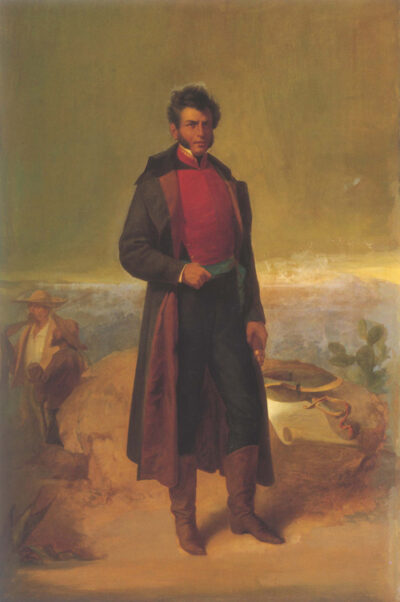
Vicente Guerrero
Vicente Guerrero was a leading revolutionary generals of the War of Independence and President of Mexico. Born August 10, 1782, in Tixtla de Guerrero. Died February 14, 1831, in Cuilápam de Guerrero. Positions held include President of Mexico (1829).
Facts
13 facts · 2 confirmed by two sources · 1 cited · 10 from one source
Where this comes from
Papalocal keeps its own record. It started from these sources; what each one said is kept here as it was copied, so a change on their side never changes this page by itself. Tap one to read its version.
What Wikidata says · copied November 16, 2026 · revision 2563045255
- Described as
- leading revolutionary generals of the War of Independence and President of Mexico (1782-1831)
- Other names
- Vicente Ramón Guerrero Saldaña
- Born
- August 10, 1782 · 5 references
- Died
- February 14, 1831 · 5 references
- Born in
- Tixtla de Guerrero
- Died in
- Cuilápam de Guerrero
- Buried in
- Panteón de San Fernando · 1 reference
- Name at birth
- Vicente Ramón Guerrero
- Citizen of
- Mexico; New Spain
- Occupation
- military personnel; politician
- Positions held
- President of Mexico (1829)
- Military branch
- Mexican Army
- Military rank
- general
- Wikipedias with a page
- 48
Wikidata item Q315618 (wikidata.org/wiki/Q315618), public domain (CC0). Copied November 16, 2026.
What Wikipedia says · copied November 16, 2026 · revision 1385642193
Vicente Ramón Guerrero Saldaña (Spanish: [biˈsente raˈmoŋ ɡeˈreɾo]; baptized 10 August 1782 – 14 February 1831) was a Mexican military officer, guerrilla commander, and statesman who played a central role in the Mexican War of Independence and served as the nation's second president in 1829. Later official memory has also styled him a consummator of independence and a founder of the First Mexican Republic.
Born in Tixtla to a family of modest means, he worked as an arriero before joining the insurgent army of José María Morelos in late 1810. Assigned to deal with local Indigenous communities, he used Spanish and Indigenous languages to recruit and hold support in Morelos's southern campaign. After Morelos's capture and execution in December 1815, Guerrero became one of the last major insurgent commanders still in the field and, from 1816 to 1821, kept the war alive by guerrilla warfare in the Tierra Caliente, refusing viceregal offers of pardon. In early 1821, with the restored Constitution of Cádiz unsettling New Spain and with royalist columns unable to finish him, Guerrero and Agustín de Iturbide opened talks. Guerrero’s terms were total independence and citizenship without caste distinction; Iturbide issued those terms, with a Catholic establishment and a constitutional monarchy, in the Plan of Iguala of 24 February 1821. Their combined troops formed the Ejército Trigarante and entered Mexico City on 27 September 1821, consummating independence.
Guerrero accepted the First Mexican Empire, but when Iturbide dissolved Congress, he joined the republican rising that forced the latter's abdication and later served on the provisional Supreme Executive Power. In the 1828 presidential election the state legislatures chose the moderate Manuel Gómez Pedraza and revolts in favor of Guerrero soon followed including by Antonio López de Santa Anna in Veracruz. As unrest and sacking continued in the capital Gómez Pedraza resigned and fled the country. Congress annulled the vote and named Guerrero president, with Anastasio Bustamante as vice president; the term began on 1 April 1829.
Facing a Spanish reconquest landing, Congress granted him facultades extraordinarias. He used them, among other acts, to abolish slavery on 15 September 1829. On 4 December 1829 Bustamante's reserve army pronounced the Plan of Jalapa. Guerrero was deposed on 17 December, retreated to his Independence War stronghold in the south, and waged the Guerra del Sur with allies including Juan Álvarez. Betrayed and seized at Acapulco in January 1831, he was condemned by a summary court-martial and shot at Cuilapan, Oaxaca, on 14 February 1831. Liberals denounced the execution as judicial murder; the main southern rebellion collapsed with him.
- Born, in its opening lines
- August 10, 1782
- Died, in its opening lines
- February 14, 1831
From the Wikipedia article “Vicente Guerrero” (en.wikipedia.org/wiki/Vicente_Guerrero), by its contributors, under CC BY-SA 4.0 (creativecommons.org/licenses/by-sa/4.0/). Copied November 16, 2026; not changed.
Confirmed Two sources agree. Cited One source, and it names where it got it. One source One source, without a reference of its own. Sources disagree The sources disagree. We show the best-supported value and keep theirs below.
