
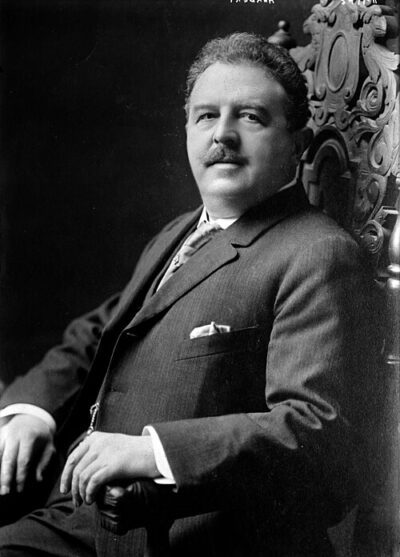
Victor Herbert
Victor Herbert was an American composer. Born February 1, 1859, in Dublin. Died May 26, 1924, in New York City. Educated at State University of Music and Performing Arts Stuttgart.
Facts
17 facts · 2 confirmed by two sources · 6 cited · 8 from one source · 1 where the sources disagree
What’s different
- Born in: we show Dublin (Sources disagree). Wikidata also lists Guernsey
Where this comes from
Papalocal keeps its own record. It started from these sources; what each one said is kept here as it was copied, so a change on their side never changes this page by itself. Tap one to read its version.
What Wikidata says · copied November 16, 2026 · revision 2565544200
- Described as
- American composer (1859–1924)
- Other names
- Victor August Herbert
- Born
- February 1, 1859 · 10 references
- Died
- May 26, 1924 · 8 references
- Born in
- Dublin · 1 reference; Guernsey · 1 reference
- Died in
- New York City · 3 references
- Buried in
- Woodlawn Cemetery · 1 reference
- Citizen of
- United Kingdom of Great Britain and Ireland; United States
- Occupation
- composer · 1 reference; conductor · 2 references; screenwriter; cellist · 2 references
- Education
- State University of Music and Performing Arts Stuttgart
- Member of
- American Academy of Arts and Letters
- Genre
- operetta
- Instrument
- cello
- Spouse
- Therese Förster · 1 reference
- Website
- https://vherbert.com/
- Wikipedias with a page
- 22
Wikidata item Q1275145 (wikidata.org/wiki/Q1275145), public domain (CC0). Copied November 16, 2026.
What Wikipedia says · copied November 16, 2026 · revision 1382464054
Victor August Herbert (February 1, 1859 – May 26, 1924) was an American composer, cellist and conductor of English and Irish ancestry and German training. Although Herbert enjoyed important careers as a cello soloist and conductor, he is best known for composing many successful operettas that premiered on Broadway from the 1890s to World War I. He was also prominent among the Tin Pan Alley composers and was later a founder of the American Society of Composers, Authors, and Publishers (ASCAP). A prolific composer, Herbert produced two operas, a cantata, 43 operettas, incidental music to 10 plays, 31 compositions for orchestra, nine band compositions, nine cello compositions, five violin compositions with piano or orchestra, 22 piano compositions and numerous songs, choral compositions and orchestrations of works by other composers, among other music.
In the early 1880s, Herbert began a career as a cellist in Vienna and Stuttgart, during which he began to compose orchestral music. Herbert and his opera singer wife, Therese Förster, moved to the U.S. in 1886 when both were engaged by the Metropolitan Opera. In the U.S., Herbert continued his performing career, while also teaching at the National Conservatory of Music, conducting and composing. His most notable instrumental compositions were his Cello Concerto No. 2 in E minor, Op. 30 (1894), which entered the standard repertoire, and his Auditorium Festival March (1901). He conducted the Pittsburgh Symphony from 1898 to 1904 (taking over from founding conductor Frederic Archer) and then founded the Victor Herbert Orchestra, which he conducted throughout the rest of his life.
Herbert began to compose operettas in 1894, producing several successes, including The Serenade (1897) and The Fortune Teller (1898). Some of the operettas that he wrote after the turn of the 20th century were even more successful: Babes in Toyland (1903), Mlle. Modiste (1905), The Red Mill (1906), Naughty Marietta (1910), Sweethearts (1913) and Eileen (1917). After World War I, with the change of popular musical tastes, Herbert began to compose musicals and contributed music to other composers' shows. While some of these were well-received, he never again achieved the level of success that he had enjoyed with his most popular operettas.
- Born, in its opening lines
- February 1, 1859
- Died, in its opening lines
- May 26, 1924
From the Wikipedia article “Victor Herbert” (en.wikipedia.org/wiki/Victor_Herbert), by its contributors, under CC BY-SA 4.0 (creativecommons.org/licenses/by-sa/4.0/). Copied November 16, 2026; not changed.
Confirmed Two sources agree. Cited One source, and it names where it got it. One source One source, without a reference of its own. Sources disagree The sources disagree. We show the best-supported value and keep theirs below.
