
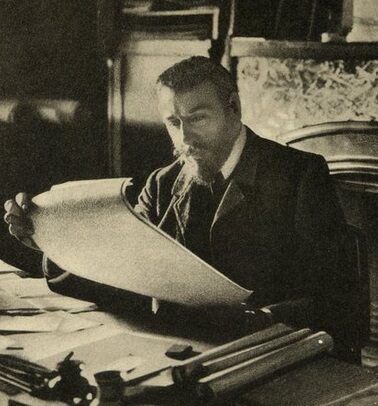
Victor Horta
Victor Horta was a Belgian architect, designer, publicist, teacher and creator of Art Nouveau. Born January 6, 1861, in Ghent. Died September 8, 1947, in Brussels. Known for Hôtel Tassel, Hôtel Solvay and Hôtel van Eetvelde. Educated at Royal Academy of Fine Arts of Brussels. Awards include Officer of the Order of the Crown.
Facts
28 facts · 2 confirmed by two sources · 9 cited · 17 from one source
Where this comes from
Papalocal keeps its own record. It started from these sources; what each one said is kept here as it was copied, so a change on their side never changes this page by itself. Tap one to read its version.
What Wikidata says · copied November 16, 2026 · revision 2559493899
- Described as
- Belgian architect, designer, publicist, teacher and creator of Art Nouveau (1861–1947)
- Other names
- Victor, baron Horta, Victor Petrus Horta Horta, Victor Horta baron, Victor Petrus Horta, Victor Pierre Horta, Victor, Baron Horta
- Born
- January 6, 1861 · 11 references
- Died
- September 8, 1947 · 7 references
- Born in
- Ghent · 4 references
- Died in
- Brussels · 3 references
- Buried in
- Ixelles Cemetery
- Citizen of
- Belgium · 1 reference
- Occupation
- architect · 3 references; designer; urban planner · 2 references; teacher · 1 reference; general contractor · 1 reference
- Education
- Royal Academy of Fine Arts of Brussels
- Known for
- Hôtel Tassel; Hôtel Solvay; Hôtel van Eetvelde; House & Atelier Horta; Centre for Fine Arts; Maison du Peuple; Hôtel Aubecq
- Awards
- Officer of the Order of the Crown
- Field
- architecture · 1 reference
- Spouse
- Pauline Heyse (1881–1906); Julia Carlsson (1908–)
- Children
- Marguerite Horta; Simonne Horta
- Father
- Pierre Horta
- Mother
- Henriette Coppieters
- Lived in
- House & Atelier Horta (1901–1915) · 1 reference
- Wikipedias with a page
- 54
Wikidata item Q49744 (wikidata.org/wiki/Q49744), public domain (CC0). Copied November 16, 2026.
What Wikipedia says · copied November 16, 2026 · revision 1382450978
Victor Pierre Horta (French: [viktɔʁ ɔʁta]; Victor, Baron Horta after 1932; 6 January 1861 – 8 September 1947) was a Belgian architect and designer, and one of the founders of the Art Nouveau movement. He was a fervent admirer of the French architectural theorist Eugène Viollet-le-Duc; his Hôtel Tassel in Brussels (1892–93), often considered the first Art Nouveau house, is based on the work of Viollet-le-Duc. The curving stylized vegetal forms that Horta used in turn influenced many others, including the French architect Hector Guimard, who used it in the first Art Nouveau apartment building he designed in Paris and in the entrances he designed for the Paris Metro. He is also considered a precursor of modern architecture for his open floor plans and his innovative use of iron, steel and glass.
Horta's later work moved away from Art Nouveau, and became more geometric and formal, with classical touches, such as columns. He made a highly original use of steel frames and skylights to bring light into the structures, open floor plans, and finely-designed decorative details. His later major works included the Maison du Peuple/Volkshuis (1895–1899), Brussels' Centre for Fine Arts (1923–1929) and Brussels-Central railway station (1913–1952). In 1932, King Albert I conferred on Horta the title of Baron for his services to the field of architecture.
After Art Nouveau lost favor, many of Horta's buildings were abandoned, or even destroyed, though his work has since been rehabilitated. Four of the buildings he designed in Brussels were added to the UNESCO World Heritage List in 2000: the Hôtel Tassel, the Hôtel Solvay, the Hôtel van Eetvelde and the Horta House (currently the Horta Museum).
- Born, in its opening lines
- January 6, 1861
- Died, in its opening lines
- September 8, 1947
From the Wikipedia article “Victor Horta” (en.wikipedia.org/wiki/Victor_Horta), by its contributors, under CC BY-SA 4.0 (creativecommons.org/licenses/by-sa/4.0/). Copied November 16, 2026; not changed.
Confirmed Two sources agree. Cited One source, and it names where it got it. One source One source, without a reference of its own. Sources disagree The sources disagree. We show the best-supported value and keep theirs below.
