
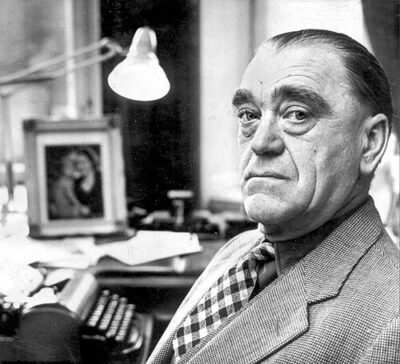
Vilhelm Moberg
Vilhelm Moberg was a Swedish journalist, author, playwright, historian, and debater. Born August 20, 1898, in Moshultamåla. Died August 8, 1973, in Väddö. Known for The Emigrants. Awards include Samfundet De Nio's Grand Prize and BMF plaque.
Facts
18 facts · 2 confirmed by two sources · 9 cited · 7 from one source
Where this comes from
Papalocal keeps its own record. It started from these sources; what each one said is kept here as it was copied, so a change on their side never changes this page by itself. Tap one to read its version.
What Wikidata says · copied November 17, 2026 · revision 2568064377
- Described as
- Swedish journalist, author, playwright, historian, and debater (1898–1973)
- Other names
- Karl Artur Vilhelm Moberg
- Born
- August 20, 1898 · 9 references
- Died
- August 8, 1973 · 7 references
- Born in
- Moshultamåla · 1 reference
- Died in
- Väddö · 1 reference
- Buried in
- Norra begravningsplatsen (1973–) · 3 references
- Cause of death
- drowning
- Name at birth
- Karl Artur Vilhelm Moberg
- Citizen of
- Sweden · 1 reference
- Occupation
- journalist · 1 reference; historian · 1 reference; writer · 3 references; playwright · 1 reference; autobiographer · 1 reference
- Known for
- The Emigrants
- Awards
- Samfundet De Nio's Grand Prize (1939) · 1 reference; BMF plaque (1953)
- Children
- Eva Moberg; Alfhild Birgitta Råd
- Wikipedias with a page
- 27
Wikidata item Q365406 (wikidata.org/wiki/Q365406), public domain (CC0). Copied November 17, 2026.
What Wikipedia says · copied November 17, 2026 · revision 1373085411
Karl Artur Vilhelm Moberg (20 August 1898 – 8 August 1973) was a Swedish journalist, author, playwright, historian, and debater. His literary career, spanning more than 45 years, is associated with his four‑volume series The Emigrants. The novels, published between 1949 and 1959, deal with the Swedish emigration to the United States in the 19th century. They have been adapted for a total of three movies (two in the 1970s and one in 2021), and a musical.
Among his other works are Raskens (1927) and Ride This Night (1941), a historical novel of a 17th‑century rebellion in Småland, acknowledged for its subliminal but widely recognised criticism of the Hitler regime.
A prominent public intellectual and debater in Sweden, Moberg was recognized for his vocal criticism of the Swedish monarchy (most notably after the Haijby affair), describing it as a servile government by divine mandate, and publicly supporting its replacement with a Swiss‑style confederal republic. He spoke out aggressively against the policies of Nazi Germany, the Greek military junta, and the Soviet Union, and his works were among those destroyed in Nazi book burnings. In 1971, he scolded Prime Minister Olof Palme for refusing to present the Nobel Prize in Literature to its recipient Alexander Solzhenitsyn – who was refused permission to attend the ceremony in Stockholm – through the Swedish embassy in Moscow.
Moberg's suicide by self‑inflicted drowning drew much attention. He had had a long struggle with depression and writer's block.
- Born, in its opening lines
- August 20, 1898
- Died, in its opening lines
- August 8, 1973
From the Wikipedia article “Vilhelm Moberg” (en.wikipedia.org/wiki/Vilhelm_Moberg), by its contributors, under CC BY-SA 4.0 (creativecommons.org/licenses/by-sa/4.0/). Copied November 17, 2026; not changed.
Confirmed Two sources agree. Cited One source, and it names where it got it. One source One source, without a reference of its own. Sources disagree The sources disagree. We show the best-supported value and keep theirs below.
