
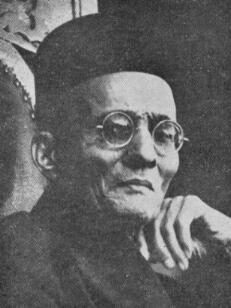
Vinayak Damodar Savarkar
Vinayak Damodar Savarkar was an Indian politician. Born May 28, 1883, in Bhagur. Died February 26, 1966, in Mumbai. Known for Hindutva, Essentials of Hindutva and Abhinav Bharat Society. Educated at University of Mumbai and Fergusson College.
Facts
27 facts · 2 confirmed by two sources · 2 cited · 23 from one source
Where this comes from
Papalocal keeps its own record. It started from these sources; what each one said is kept here as it was copied, so a change on their side never changes this page by itself. Tap one to read its version.
What Wikidata says · copied November 16, 2026 · revision 2563965865
- Described as
- Indian politician (1883–1966)
- Other names
- Swatantryaveer Savarkar, Veer Savarkar, Vināyaka Dāmodara Sāvarakara
- Born
- May 28, 1883 · 2 references
- Died
- February 26, 1966 · 2 references
- Born in
- Bhagur
- Died in
- Mumbai
- Cause of death
- hunger strike
- Citizen of
- British Raj (–1947); India (1950–); Dominion of India (1947–1950)
- Occupation
- poet; philosopher; politician · 1 reference; playwright; freedom fighter; prose writer; revolutionary · 1 reference; writer · 1 reference
- Political party
- Akhil Bharatiya Hindu Mahasabha
- Education
- University of Mumbai; Fergusson College
- Known for
- Hindutva; Essentials of Hindutva · 1 reference; Abhinav Bharat Society · 1 reference; The Indian War of Independence · 1 reference
- Father
- Damodar Savarkar
- Siblings
- Ganesh Damodar Savarkar; Narayan Damodar Savarkar
- Religion
- atheism
- Wikipedias with a page
- 43
Wikidata item Q471040 (wikidata.org/wiki/Q471040), public domain (CC0). Copied November 16, 2026.
What Wikipedia says · copied November 16, 2026 · revision 1385433558
Vinayak Damodar Savarkar (Marathi: विनायक दामोदर सावरकर; 28 May 1883 – 26 February 1966) was an Indian politician and ideologue. He developed the Hindu nationalist political ideology of Hindutva in his 1923 pamphlet entitled Essentials of Hindutva, published while he was incarcerated at Ratnagiri.
Savarkar began his political activities as a high school student and continued at Fergusson College in Pune. He and his brother founded a secret society called Abhinav Bharat Society. When Savarkar travelled to England for his law studies, he involved himself with organisations such as India House and the Free India Society. He also published books advocating complete Indian independence by revolutionary means.
In 1910, Savarkar was arrested by British authorities and deported back to India as a result of his involvement with India House. Upon returning to India, Savarkar was sentenced to 50 years of imprisonment in the Cellular Jail in the Andaman and Nicobar Islands. He was released in 1924 after writing a series of mercy petitions to the British colonial government. According to historian A. Devare, Savarkar “virtually ceased” his criticism of British rule in India after his release from the Cellular Jail in 1924. He remained restricted to Ratnagiri district and prohibited from political activity until 1937. Savarkar started travelling widely, becoming a prominent orator and writer who advocated for Hindu political and social unity. In his 1937 Ahmedabad presidential address, Savarkar described Hindus and Muslims as “two nations in the main” in India, a position that has been interpreted by scholars as an expression of the two-nation theory. The Hindu Mahasabha under Savarkar's leadership endorsed the idea of India as a Hindu Rashtra (Hindu nation).
In 1939, the ruling Indian National Congress (INC) resigned en masse after Britain declared India a belligerent in World War II. The Hindu Mahasabha under Savarkar formed alliances with the All-India Muslim League and other non-INC parties to form government in many states. Subsequently, the INC, under Gandhi's leadership, launched the Quit India Movement; Savarkar boycotted the movement, writing a letter titled "Stick to your Posts" and recruiting Indians for the British war effort. In 1948, Savarkar was tried for his alleged involvement in the conspiracy to assassinate Mahatma Gandhi but was acquitted for lack of sufficient evidence. The Justice Jeevan Lal Kapur Commission into Gandhi's murder later concluded that Savarkar was involved in the crime. Savarkar died before the commission's final report, having intentionally starved himself to death in a ceremonial fast. In 2017, the Supreme Court of India set up an amicus curiae under Additional Solicitor General Amarendra Sharan to investigate into the case. The report submitted by the amicus curiae states "since the late Vinayak D. Savarkar had been acquitted, at this stage, it would neither be advisable/ desirable nor possible to come to a definitive finding with respect to Vinayak D. Savarkar’s role in the assassination of Mahatma Gandhi."
- Born, in its opening lines
- May 28, 1883
- Died, in its opening lines
- February 26, 1966
From the Wikipedia article “Vinayak Damodar Savarkar” (en.wikipedia.org/wiki/Vinayak_Damodar_Savarkar), by its contributors, under CC BY-SA 4.0 (creativecommons.org/licenses/by-sa/4.0/). Copied November 16, 2026; not changed.
Confirmed Two sources agree. Cited One source, and it names where it got it. One source One source, without a reference of its own. Sources disagree The sources disagree. We show the best-supported value and keep theirs below.
