
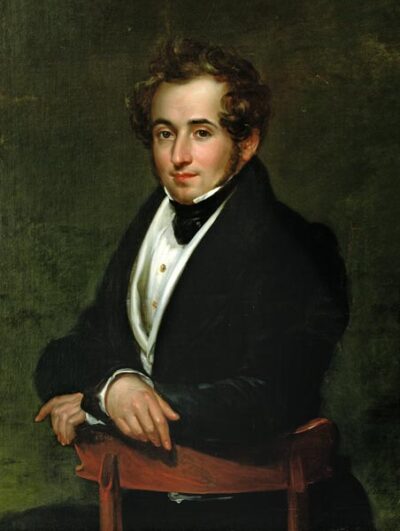
Vincenzo Bellini
Vincenzo Bellini was an Italian opera composer. Born November 3, 1801, in Catania. Died September 23, 1835, in Puteaux. Known for Norma, La sonnambula and I Capuleti e i Montecchi. Awards include Knight of the Legion of Honour.
Facts
25 facts · 2 confirmed by two sources · 9 cited · 14 from one source
Where this comes from
Papalocal keeps its own record. It started from these sources; what each one said is kept here as it was copied, so a change on their side never changes this page by itself. Tap one to read its version.
What Wikidata says · copied November 16, 2026 · revision 2567719342
- Described as
- Italian opera composer (1801–1835)
- Other names
- Vincenzo Salvatore Carmelo Francesco Bellini, Bellini
- Born
- November 3, 1801 · 15 references
- Died
- September 23, 1835 · 14 references
- Born in
- Catania · 4 references
- Died in
- Puteaux · 2 references
- Buried in
- Père Lachaise Cemetery (1835–1876) · 1 reference; Catania Cathedral (1876–) · 1 reference
- Cause of death
- dysentery
- Name at birth
- Vincenzo Salvatore Carmelo Francesco Bellini
- Citizen of
- Kingdom of Sicily
- Occupation
- composer · 1 reference
- Member of
- Accademia Tiberina
- Genre
- opera; symphony
- Known for
- Norma; La sonnambula; I Capuleti e i Montecchi; I puritani; La straniera; Mass in A minor
- Awards
- Knight of the Legion of Honour
- Field
- music · 1 reference; opera · 1 reference
- Siblings
- Carmelo Bellini · 1 reference; Mario Bellini · 1 reference
- Lived in
- Villa Passalacqua
- Wikipedias with a page
- 69
Wikidata item Q170209 (wikidata.org/wiki/Q170209), public domain (CC0). Copied November 16, 2026.
What Wikipedia says · copied November 16, 2026 · revision 1383879979
Vincenzo Salvatore Carmelo Francesco Bellini (3 November 1801 – 23 September 1835) was an Italian opera composer of the early Romantic era famed for his long, graceful melodies and evocative musical settings. A central figure of the bel canto era, he was admired not only by the public but also by many composers who were influenced by his work. His songs balanced florid embellishment with a deceptively simple approach to lyric setting.
Born to a musical family in Sicily, he distinguished himself early and earned a scholarship to study under several noted musicians at Naples' Real Collegio di Musica. There he absorbed elements of the Neapolitan School's style and was inspired by performances of Donizetti's and Rossini's operas, among others, in more modern idioms. He wrote his first opera, Adelson e Salvini (1825), for the conservatory, and his next, Bianca e Fernando (1826), on a Teatro di San Carlo-affiliated commission for promising students. He also became close friends with his peer and first biographer, Francesco Florimo.
Bellini then went to Milan to compose for La Scala, where the success of Il pirata (1827) established his short but significant career. He wrote many celebrated operas, ascending to triumphal heights with I Capuleti e i Montecchi (1830, La Fenice), La sonnambula (1831, Teatro Carcano), and more gradually Norma (1831, La Scala). He travelled abroad and wrote I puritani after a visit to London. Its successful premiere (1835, Théâtre-Italien) capped an illustrious international career. Bellini died at the age of 33 in Puteaux, France.
Verdi praised Bellini's expansive melodies as unequaled, while Wagner, who was rarely complimentary, was captivated by Bellini's expressive integration of music and text. Liszt and Chopin were also admirers, though Berlioz was less enthusiastic. Most musicologists now assess Bellini positively, though some question the quality of his work. Many of his operas, including Pirata, Capuleti, Sonnambula, Norma, and Puritani are regularly performed at major opera houses throughout the world.
- Born, in its opening lines
- November 3, 1801
- Died, in its opening lines
- September 23, 1835
From the Wikipedia article “Vincenzo Bellini” (en.wikipedia.org/wiki/Vincenzo_Bellini), by its contributors, under CC BY-SA 4.0 (creativecommons.org/licenses/by-sa/4.0/). Copied November 16, 2026; not changed.
Confirmed Two sources agree. Cited One source, and it names where it got it. One source One source, without a reference of its own. Sources disagree The sources disagree. We show the best-supported value and keep theirs below.
