
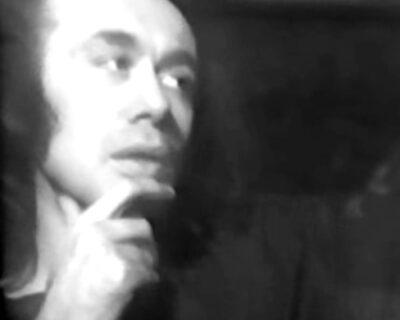
Vito Acconci
Vito Acconci was an American designer, landscape architect, performance and installation artist. Born January 24, 1940, in New York City. Died April 27, 2017, in New York City. Known for Walkways Through the Wall, Wall-Slide and Wavewall. Educated at College of the Holy Cross and Regis High School. Awards include Guggenheim Fellowship, Rome Prize and New York Foundation for the Arts.
Facts
34 facts · 2 confirmed by two sources · 17 cited · 14 from one source · 1 where the sources disagree
What’s different
- Cause of death: we show stroke (Sources disagree). Wikidata also lists cerebrovascular disease
Where this comes from
Papalocal keeps its own record. It started from these sources; what each one said is kept here as it was copied, so a change on their side never changes this page by itself. Tap one to read its version.
What Wikidata says · copied November 15, 2026 · revision 2558274204
- Described as
- American designer, landscape architect, performance and installation artist (1940-2017)
- Other names
- Vito Hannibal Acconci, Vito Acconi
- Born
- January 24, 1940 · 15 references
- Died
- April 27, 2017 · 5 references
- Born in
- New York City · 1 reference
- Died in
- New York City · 1 reference
- Cause of death
- stroke; cerebrovascular disease
- Citizen of
- United States · 4 references
- Occupation
- architect · 1 reference; visual artist · 2 references; poet · 2 references; landscape architect · 2 references; illustrator · 2 references; video artist · 3 references; television producer · 1 reference; photographer · 2 references
- Worked for
- Brooklyn College
- Education
- College of the Holy Cross; Regis High School
- Genre
- performance art · 1 reference; installation art · 1 reference
- Known for
- Walkways Through the Wall; Wall-Slide · 1 reference; Wavewall · 1 reference
- Awards
- Guggenheim Fellowship · 1 reference; Rome Prize; New York Foundation for the Arts (2000) · 1 reference
- Field
- architecture; performance art; installation art; video art; visual arts · 1 reference; performance artwork · 1 reference
- Spouse
- Maria Acconci (2014–2017); Rosemary Mayer (1962–) · 1 reference
- Website
- http://acconci.com/
- Wikipedias with a page
- 31
Wikidata item Q433471 (wikidata.org/wiki/Q433471), public domain (CC0). Copied November 15, 2026.
What Wikipedia says · copied November 15, 2026 · revision 1377978171
Vito Acconci (Italian: [ˈviːto akˈkontʃi], ; January 24, 1940 – April 27, 2017) was an American performance, video and installation artist, whose diverse practice eventually included sculpture, architectural design, and landscape design. His performance and video art was characterized by "existential unease," exhibitionism, discomfort, transgression and provocation, as well as wit and audacity, and often involved crossing boundaries such as public–private, consensual–nonconsensual, and real world–art world. His work is considered to have influenced artists including Laurie Anderson, Karen Finley, Bruce Nauman, and Tracey Emin, among others.
Acconci was initially interested in radical poetry, creating 0 to 9 Magazine, but by the late 1960s he began creating Situationist-influenced performances in the street or for small audiences that explored the body and public space. Two of his most famous pieces were Following Piece (1969), in which he selected random passersby on New York City streets and followed them for as long as he was able, and Seedbed (1972), in which he claimed that he masturbated while under a temporary floor at the Sonnabend Gallery, as visitors walked above and heard him speaking.
In the late-1970s, he turned to sculpture, architecture and design, greatly increasing the scale of his work, if not his art world profile. Over the next two decades he developed public artworks and parks, airport rest areas, artificial islands and other architectural projects that frequently embraced participation, change and playfulness. Notable works of this period include: Personal Island, designed for Zwolle, the Netherlands (1994); Walkways Through the Wall at the Wisconsin Center, in Milwaukee, WI (1998); and Murinsel, for Graz, Austria (2003). Retrospectives of Acconci's work have been organized by the Stedelijk Museum in Amsterdam (1978) and the Museum of Contemporary Art, Chicago (1980), and his work is in numerous public collections, including those of the Museum of Modern Art and Whitney Museum of American Art. He has been recognized with fellowships from the National Endowment for the Arts (1976, 1980, 1983, 1993), John Simon Guggenheim Memorial Foundation (1979), and American Academy in Rome (1986). In addition to his art and design work, Acconci taught at many higher learning institutions. Acconci died on April 28, 2017, in Manhattan at age 77.
- Born, in its opening lines
- January 24, 1940
- Died, in its opening lines
- April 27, 2017
From the Wikipedia article “Vito Acconci” (en.wikipedia.org/wiki/Vito_Acconci), by its contributors, under CC BY-SA 4.0 (creativecommons.org/licenses/by-sa/4.0/). Copied November 15, 2026; not changed.
Confirmed Two sources agree. Cited One source, and it names where it got it. One source One source, without a reference of its own. Sources disagree The sources disagree. We show the best-supported value and keep theirs below.
