
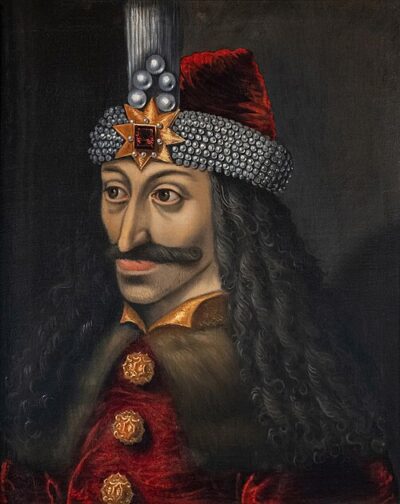
Vlad the Impaler
Vlad the Impaler was the 15th-century ruler of Wallachia. Born 1431, in Sighișoara. Died December 14, 1476, in Bucharest. Positions held include monarch, voivode (1460–) and lord of Wallachia (3 times) (1448–1476).
Facts
22 facts · 0 confirmed by two sources · 9 cited · 11 from one source · 2 where the sources disagree
What’s different
- Born: we show 1431 (Sources disagree). Wikidata also lists November 2, 1431
- Died: we show December 14, 1476 (Sources disagree). Wikidata also lists January 1477
Where this comes from
Papalocal keeps its own record. It started from these sources; what each one said is kept here as it was copied, so a change on their side never changes this page by itself. Tap one to read its version.
What Wikidata says · copied November 16, 2026 · revision 2567487652
- Described as
- 15th-century ruler of Wallachia
- Other names
- Vlad III the Impaler, Vlad Dracula, Vlad III Dracula, Vladimir Tepes, Vlad Tepes, Vlad Țepeș, Vlad Drăculești, Vlad Draculea, Vlad III Dracul 'the Impaler'
- Born
- 1431 · 1 reference; November 2, 1431 · 1 reference
- Died
- December 14, 1476; January 1477
- Born in
- Sighișoara · 1 reference
- Died in
- Bucharest · 1 reference
- Buried in
- Snagov Monastery · 1 reference
- Cause of death
- decapitation · 1 reference
- Citizen of
- Principality of Wallachia
- Occupation
- ruler
- Positions held
- monarch; voivode (1460–) · 1 reference; lord of Wallachia (3 times) (1448–1476) · 1 reference
- Spouse
- Ilona Szilágyi · 1 reference
- Children
- Mihnea cel Rău · 2 references; Vlad Drakulya · 1 reference
- Father
- Vlad II Dracul · 1 reference
- Mother
- Vasilissa · 1 reference
- Siblings
- Radu cel Frumos; Vlad Călugărul; Mircea II of Wallachia
- Religion
- Eastern Orthodoxy; Catholicism · 1 reference
- Lived in
- Poenari Castle · 1 reference
- Wikipedias with a page
- 91
Wikidata item Q43715 (wikidata.org/wiki/Q43715), public domain (CC0). Copied November 16, 2026.
What Wikipedia says · copied November 16, 2026 · revision 1385947214
Vlad III (1428–31 – 1476/77), commonly known as Vlad the Impaler (Romanian: Vlad Țepeș [ˈvlad ˈtsepeʃ]) or Vlad Dracula ( DRAK-yuu-lə, -yə-; Romanian: Vlad Drăculea [ˈdrəkule̯a]), was Voivode of Wallachia during three separate reigns (1448, 1456–1462, and 1476). He was born in the House of Drăculești, as the son of Vlad II Dracul. Vlad is chiefly remembered for his efforts to strengthen central authority, suppress the power of rival boyars, and resist the expansion of the Ottoman Empire. His 1462 campaign against Sultan Mehmed II, including the Night Attack at Târgoviște, became one of the most notable military episodes of his reign. He was killed in battle in 1476 or 1477 during his final attempt to retain the Wallachian throne.
He was the second son of Vlad Dracul, who became the ruler of Wallachia in 1436. Vlad and his younger brother, Radu, were held as hostages in the Ottoman Empire in 1442 to secure their father's loyalty. Vlad's eldest brother Mircea and their father were murdered after John Hunyadi, regent-governor of Hungary, invaded Wallachia in 1447. Hunyadi installed Vlad's second cousin, Vladislav II, as the new voivode. Hunyadi launched a military campaign against the Ottomans in the autumn of 1448, and Vladislav accompanied him. Vlad broke into Wallachia with Ottoman support in October, but Vladislav returned, and Vlad sought refuge in the Ottoman Empire before the end of the year. Vlad went to Moldavia in 1449 or 1450 and later to Hungary.
Relations between Hungary and Vladislav later deteriorated, and in 1456 Vlad invaded Wallachia with Hungarian support. After killing Vladislav, Vlad began a purge among the Wallachian boyars to strengthen his position. He came into conflict with the Transylvanian Saxons, who supported his opponents, Dan and Basarab Laiotă (who were Vladislav's brothers), and Vlad's illegitimate half-brother, Vlad Călugărul. Vlad plundered the Saxon villages, taking the captured people to Wallachia, where he had them impaled (which inspired his epithet). Peace was restored in 1460.
The Ottoman Sultan, Mehmed II, ordered Vlad to pay homage to him personally, but Vlad had the Sultan's two envoys captured and impaled. In January 1462, he attacked Ottoman territory, massacring tens of thousands of Turks and Muslim Bulgarians. Mehmed launched a campaign against Wallachia to replace Vlad with Vlad's younger brother, Radu. Vlad attempted to capture the sultan at Târgoviște during the night of 16–17 June 1462. The Sultan and the main Ottoman army left Wallachia, but many Wallachians deserted Vlad's forces and joined Radu. Vlad went to Transylvania to seek assistance from Matthias Corvinus, King of Hungary, in late 1462, but Corvinus had him imprisoned.
Vlad was held in captivity in Visegrád from 1463 to 1475. During this period, anecdotes about his cruelty started to spread in Germany and Italy. He was released at the request of Stephen III of Moldavia in the summer of 1475. Vlad was reputedly forced to convert to Roman Catholicism (from Eastern Orthodoxy) as part of the agreement for his release. He fought in Corvinus's army against the Ottomans in Bosnia in early 1476. Hungarian and Moldavian troops helped him to force Basarab Laiotă (who had dethroned Vlad's brother, Radu) to flee from Wallachia in November. Basarab returned with Ottoman support before the end of the year. Vlad was killed in battle near Snagov before 10 January 1477.
Books describing Vlad's cruel acts were among the first bestsellers in the German-speaking territories. In Russia, popular stories suggested that Vlad was able to strengthen his central government only by applying brutal punishments, and many 19th-century Romanian historians adopted a similar view. It is suggested that Vlad's patronymic inspired the name of Bram Stoker's literary vampire, Count Dracula. Despite this, Vlad is not directly mentioned in Stoker's notes for the novel. Implicit references are mentioned, however, such as to the 1460 Wallachian "Voivode (Dracula)" who "crossed the Danube and attacked Turkish troops."
From the Wikipedia article “Vlad the Impaler” (en.wikipedia.org/wiki/Vlad_the_Impaler), by its contributors, under CC BY-SA 4.0 (creativecommons.org/licenses/by-sa/4.0/). Copied November 16, 2026; not changed.
Confirmed Two sources agree. Cited One source, and it names where it got it. One source One source, without a reference of its own. Sources disagree The sources disagree. We show the best-supported value and keep theirs below.
