
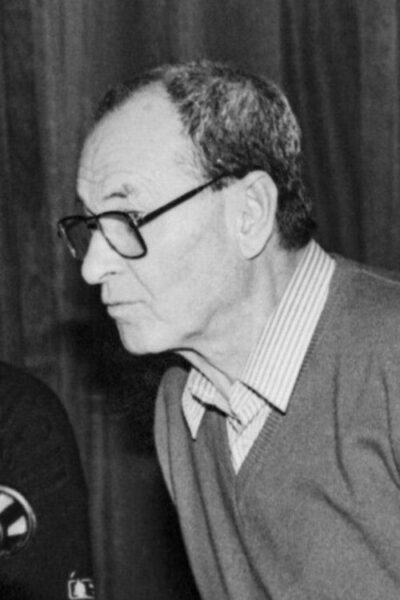
Vladimir Motyl
Vladimir Motyl was a Soviet theater and film director. Born June 26, 1927, in Liepieĺ. Died February 21, 2010, in Moscow. Educated at Yekaterinburg State Theatre Institute and Ural State University. Awards include Order of Honour, People's Artist of the Russian Federation and Honored art worker of the Russian Soviet Federative Socialist Republic.
Facts
17 facts · 2 confirmed by two sources · 4 cited · 11 from one source
Where this comes from
Papalocal keeps its own record. It started from these sources; what each one said is kept here as it was copied, so a change on their side never changes this page by itself. Tap one to read its version.
What Wikidata says · copied November 18, 2026 · revision 2567054787
- Described as
- Soviet theater and film director (1927-2010)
- Other names
- Vladimir Yakovlevich Motyl
- Born
- June 26, 1927 · 1 reference
- Died
- February 21, 2010 · 1 reference
- Born in
- Liepieĺ · 1 reference
- Died in
- Moscow · 1 reference
- Buried in
- Vostryakovo Cemetery
- Citizen of
- Soviet Union; Russia
- Occupation
- film director · 1 reference; theatre director; screenwriter · 1 reference
- Worked for
- Top Courses for Scriptwriters and Film Directors
- Education
- Yekaterinburg State Theatre Institute; Ural State University
- Awards
- Order of Honour; People's Artist of the Russian Federation; Honored art worker of the Russian Soviet Federative Socialist Republic; State Prize of the Russian Federation (1998)
- Wikipedias with a page
- 21
Wikidata item Q1927433 (wikidata.org/wiki/Q1927433), public domain (CC0). Copied November 18, 2026.
What Wikipedia says · copied November 18, 2026 · revision 1341309534
Vladimir Yakovlevich Motyl (Russian: Влади́мир Я́ковлевич Моты́ль; 26 June 1927 – 21 February 2010) was a Soviet and Russian film director and screenwriter.
Vladimir Motyl was born in Lepiel, Belarus. His father was a Polish émigré, who was arrested in 1930 and sent to Solovki and died there the following year. Many of his other relatives suffered similar treatment. Vladimir and his mother were exiled to the Northern Urals, where he became fascinated in theatre and cinema, and later graduated from the Sverdlovsk Theatrical Institute. For about 10 years he worked in various theatres in the Urals and Siberia and eventually became chief director of Sverdlovsk Young Spectator's Theatre.
He decided to start afresh in cinema, despite having no technical qualifications. Eventually he directed his first film, Children of Pamirs (1963) (Detyi Pamira/Дети Памира) in Tajikistan. This work was met with public success, as well as earning him the State Prize of Tajik SSR (1964), and the title of honorary citizen of Dushanbe (1977).
His next film Zhenya, Zhenechka and Katyusha (1967) (Женя, Женечка и "Катюша"), a romantic comedy/drama set in 1944, was warmly accepted by the public as well, but earned the displeasure of the Soviet agitprop for "disrespectful" treatment of the Second World War theme, and the director fell into disfavor.
Nevertheless, he was invited to direct a film which was to become one of the most popular Soviet cult films, the "Red Western" (or technically, "Ostern") White Sun of the Desert. Notably, this film has a strong theme about exile, as its protagonist, Sukhov finds himself waylaid in Central Asia when trying to return home.
For his work, Motyl received numerous awards.
- Born, in its opening lines
- June 26, 1927
- Died, in its opening lines
- February 21, 2010
From the Wikipedia article “Vladimir Motyl” (en.wikipedia.org/wiki/Vladimir_Motyl), by its contributors, under CC BY-SA 4.0 (creativecommons.org/licenses/by-sa/4.0/). Copied November 18, 2026; not changed.
Confirmed Two sources agree. Cited One source, and it names where it got it. One source One source, without a reference of its own. Sources disagree The sources disagree. We show the best-supported value and keep theirs below.
