
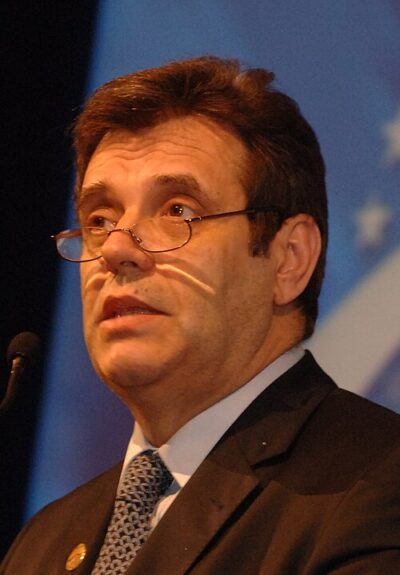
Vojislav Koštunica
Vojislav Koštunica is a Serbian politician. Born March 24, 1944, in Belgrade. Positions held include Prime Minister of Serbia (2004–2008), President of the Federal Republic of Yugoslavia (2000–2003) and President of Serbia and Montenegro (2000–2003). Educated at University of Belgrade Faculty of Law and University of Belgrade. Awards include Order of St. Sergius of Radonezh 2nd class and Knight Grand Cross with Collar of the Order of Merit of the Italian Republic.
Facts
21 facts · 1 confirmed by two sources · 1 cited · 19 from one source
Where this comes from
Papalocal keeps its own record. It started from these sources; what each one said is kept here as it was copied, so a change on their side never changes this page by itself. Tap one to read its version.
What Wikidata says · copied November 16, 2026 · revision 2569013299
- Described as
- Serbian politician
- Other names
- Dr Vojislav Kostunica, Vojisllav Koshtunica
- Born
- March 24, 1944 · 2 references
- Born in
- Belgrade · 1 reference
- Citizen of
- Serbia; Socialist Federal Republic of Yugoslavia; Federal Republic of Yugoslavia; Serbia and Montenegro
- Occupation
- politician; jurist; pedagogue
- Positions held
- Prime Minister of Serbia (2004–2008); President of the Federal Republic of Yugoslavia (2000–2003); President of Serbia and Montenegro (2000–2003)
- Political party
- New Democratic Party of Serbia (1992–); Democratic Party (1989–1992)
- Worked for
- University of Belgrade
- Education
- University of Belgrade Faculty of Law; University of Belgrade
- Awards
- Order of St. Sergius of Radonezh 2nd class; Knight Grand Cross with Collar of the Order of Merit of the Italian Republic
- Religion
- Serbian Orthodox Church
- Lived in
- Belgrade
- Wikipedias with a page
- 57
Wikidata item Q33031 (wikidata.org/wiki/Q33031), public domain (CC0). Copied November 16, 2026.
What Wikipedia says · copied November 16, 2026 · revision 1382125173
Vojislav Koštunica (born 24 March 1944) is a Serbian former politician who served as the last president of FR Yugoslavia from 2000 to 2003 and as the prime minister of Serbia from 2004 to 2008.
Koštunica won the 2000 Yugoslav presidential election as a candidate of a broad alliance Democratic Opposition of Serbia (DOS), which led to the overthrow of Slobodan Milošević and the withdrawal of international sanctions against Yugoslavia. He strictly opposed cooperation with the International Criminal Tribunal for the former Yugoslavia (ICTY) and his party left the coalition government in protest at the decision to extradite Slobodan Milošević to the ICTY. After the 2003 Serbian parliamentary election, the first elections after the dissolution of DOS and assassination of Prime Minister Zoran Đinđić, Koštunica formed a minority government with the support of Milošević's Socialist Party of Serbia and became the head of government. He was one of the crucial figures in the adoption of the first constitution of an independent Serbia, as well as for declaring Serbia a neutral country. During his second government (2007–2008), he opposed signing the Stabilisation and Association Agreement (SAA) with the European Union, leading to the fall of the government after a year and the early elections won by pro-European parties.
He was one of the founders and the first president of the Democratic Party of Serbia from its creation in 1992 until 19 March 2014, when he resigned as party president and retired from active politics after his party failed to reach the 5% threshold to enter the Parliament on March 16 elections for the first time in its history. In October 2014, he left the party after disagreements with the new party leadership over what he saw as their abandonment of the policy of political neutrality. In November 2014, he was one of the founders of the right-wing eurosceptic "Statehood Movement of Serbia".
- Born, in its opening lines
- March 24, 1944
From the Wikipedia article “Vojislav Koštunica” (en.wikipedia.org/wiki/Vojislav_Koštunica), by its contributors, under CC BY-SA 4.0 (creativecommons.org/licenses/by-sa/4.0/). Copied November 16, 2026; not changed.
Confirmed Two sources agree. Cited One source, and it names where it got it. One source One source, without a reference of its own. Sources disagree The sources disagree. We show the best-supported value and keep theirs below.
