
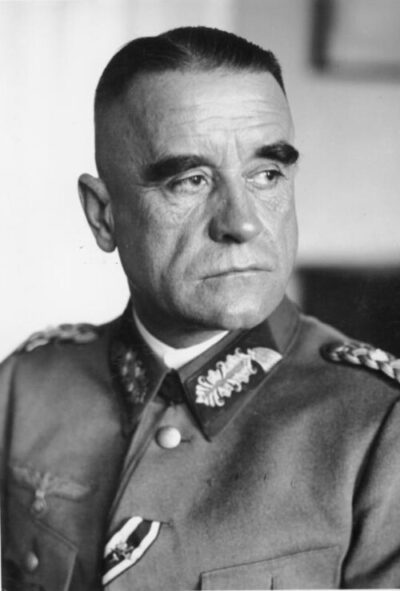
Walter Heitz
Walter Heitz was a German general. Born December 8, 1878, in Berlin. Died February 9, 1944, in Moscow. Awards include German Cross in Gold and Knight's Cross of the Iron Cross with Oak Leaves.
Facts
17 facts · 2 confirmed by two sources · 8 cited · 7 from one source
Where this comes from
Papalocal keeps its own record. It started from these sources; what each one said is kept here as it was copied, so a change on their side never changes this page by itself. Tap one to read its version.
What Wikidata says · copied November 17, 2026 · revision 2569046777
- Described as
- German general (1878–1944)
- Born
- December 8, 1878 · 1 reference
- Died
- February 9, 1944
- Born in
- Berlin · 1 reference
- Died in
- Moscow · 1 reference
- Cause of death
- cancer
- Citizen of
- German Reich
- Occupation
- military officer; military commander · 1 reference
- Awards
- German Cross in Gold; Knight's Cross of the Iron Cross with Oak Leaves
- Field
- military affairs · 1 reference; military command · 1 reference; World War II · 1 reference; World War I · 1 reference; military · 1 reference
- Military branch
- army
- Military rank
- Generaloberst
- Wikipedias with a page
- 25
Wikidata item Q61288 (wikidata.org/wiki/Q61288), public domain (CC0). Copied November 17, 2026.
What Wikipedia says · copied November 17, 2026 · revision 1381464320
Walter Heitz (8 December 1878 – 9 February 1944) was a German general (Generaloberst) in the Wehrmacht during World War II. He served as President of the Reich Military Court and commanded part of the 6th Army in the Battle of Stalingrad.
A decorated World War I officer and supporter of Nazism, Heitz advanced rapidly under the Third Reich. In 1936, he became the president of the Reich Military Court. At the age of 60, Heitz took command of the VIII Army Corps and participated in the Invasion of Poland, the Battle of France and Operation Barbarossa, the invasion of the Soviet Union. Heitz continued to command the VIII Army Corps as part of the 6th Army in the Battle of Stalingrad. The 6th Army was encircled within the city after Operation Uranus, the Soviet counter-offensive in Stalingrad, and eventually destroyed. Heitz surrendered the central pocket of German forces in Stalingrad on 31 January 1943 and died as a prisoner of war in the Soviet Union.
- Born, in its opening lines
- December 8, 1878
- Died, in its opening lines
- February 9, 1944
From the Wikipedia article “Walter Heitz” (en.wikipedia.org/wiki/Walter_Heitz), by its contributors, under CC BY-SA 4.0 (creativecommons.org/licenses/by-sa/4.0/). Copied November 17, 2026; not changed.
Confirmed Two sources agree. Cited One source, and it names where it got it. One source One source, without a reference of its own. Sources disagree The sources disagree. We show the best-supported value and keep theirs below.
