
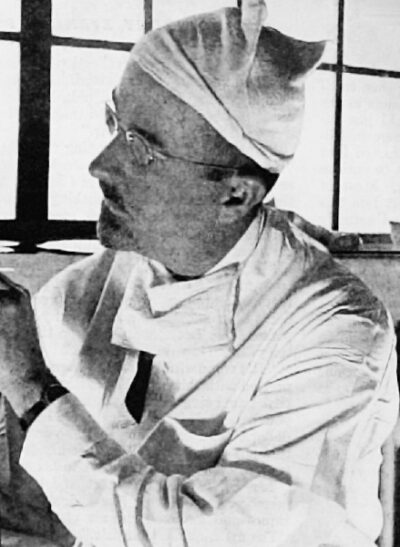
Walter Jackson Freeman II
Walter Jackson Freeman II was an American neurologist. Born November 14, 1895, in Philadelphia. Died May 31, 1972, in San Francisco. Educated at Yale University and Perelman School of Medicine at the University of Pennsylvania.
Facts
16 facts · 2 confirmed by two sources · 4 cited · 10 from one source
Where this comes from
Papalocal keeps its own record. It started from these sources; what each one said is kept here as it was copied, so a change on their side never changes this page by itself. Tap one to read its version.
What Wikidata says · copied November 18, 2026 · revision 2554119093
- Described as
- American neurologist (1895-1972)
- Other names
- Walter Freeman, Walter Jackson Freeman, Walter J. Freeman, Walter Jackson Freeman Jr., Walter J. Freeman II
- Born
- November 14, 1895 · 2 references
- Died
- May 31, 1972 · 2 references
- Born in
- Philadelphia · 1 reference
- Died in
- San Francisco
- Buried in
- Calvary Cemetery
- Citizen of
- United States
- Occupation
- physician; neurologist · 1 reference; psychiatrist · 1 reference
- Education
- Yale University; Perelman School of Medicine at the University of Pennsylvania
- Children
- Walter Jackson Freeman III
- Father
- Walter Jackson Freeman
- Mother
- Corrine Keen · 1 reference
- Siblings
- Richard Borden Freeman
- Lived in
- United States · 1 reference
- Wikipedias with a page
- 16
Wikidata item Q1669113 (wikidata.org/wiki/Q1669113), public domain (CC0). Copied November 18, 2026.
What Wikipedia says · copied November 18, 2026 · revision 1385914110
Walter Jackson Freeman II (November 14, 1895 – May 31, 1972) was an American neurologist who claimed that he specialized in lobotomy. Freeman popularized the transorbital lobotomy, often referred to as the “ice-pick” lobotomy to make the procedure faster, cheaper, and accessible for use in overcrowded psychiatric hospitals, where there were often no operating rooms, surgeons, or anesthesia and limited budgets. The transorbital approach involved placing an orbitoclast (an instrument resembling an ice pick) under the eyelid and against the top of the eye socket; a mallet was then used to drive the orbitoclast through the thin layer of bone and into the brain. Freeman's transorbital lobotomy method did not require a neurosurgeon and could be performed outside of an operating room, often by untrained psychiatrists without the use of anesthesia by using electroconvulsive therapy to induce seizure and unconsciousness. In 1947, Freeman's partner James W. Watts ended their partnership because Watts was disgusted by Freeman's modification of the lobotomy from a surgical operation into a simple "office" procedure.
Freeman and his procedure played a major role in popularizing lobotomy and spreading it around the world; he later traveled across the United States visiting mental institutions. After four decades Freeman had personally performed possibly as many as 4,000 lobotomies on patients as young as 12, despite having no surgical training. As many as 100 of his patients died of cerebral hemorrhage, and he was banned from performing surgery in 1967.
- Born, in its opening lines
- November 14, 1895
- Died, in its opening lines
- May 31, 1972
From the Wikipedia article “Walter Jackson Freeman II” (en.wikipedia.org/wiki/Walter_Jackson_Freeman_II), by its contributors, under CC BY-SA 4.0 (creativecommons.org/licenses/by-sa/4.0/). Copied November 18, 2026; not changed.
Confirmed Two sources agree. Cited One source, and it names where it got it. One source One source, without a reference of its own. Sources disagree The sources disagree. We show the best-supported value and keep theirs below.
