
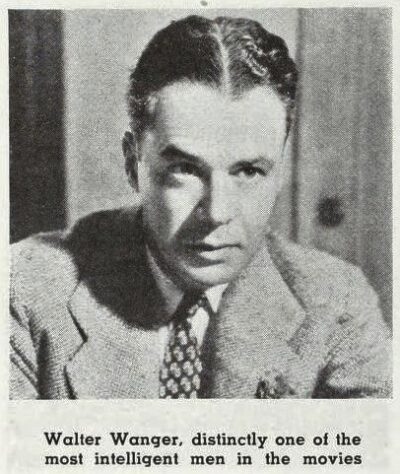
Walter Wanger
Walter Wanger was an American film producer. Born July 11, 1894, in San Francisco. Died November 18, 1968, in New York City. Educated at Dartmouth College and Cascadilla School. Awards include Academy Honorary Award.
Facts
16 facts · 2 confirmed by two sources · 5 cited · 9 from one source
Where this comes from
Papalocal keeps its own record. It started from these sources; what each one said is kept here as it was copied, so a change on their side never changes this page by itself. Tap one to read its version.
What Wikidata says · copied November 18, 2026 · revision 2563075059
- Described as
- American film producer (1894-1968)
- Born
- July 11, 1894 · 4 references
- Died
- November 18, 1968 · 4 references
- Born in
- San Francisco
- Died in
- New York City
- Buried in
- Home of Peace Cemetery and Emanu-El Mausoleum · 1 reference
- Cause of death
- disease
- Citizen of
- United States
- Occupation
- film producer · 1 reference; producer · 1 reference
- Education
- Dartmouth College; Cascadilla School
- Awards
- Academy Honorary Award
- Spouse
- Joan Bennett (1940–1965) · 1 reference; Justine Johnstone (1919–1938) · 1 reference
- Children
- Stephanie Wanger · 1 reference; Shelley Antonia Wanger · 1 reference
- Wikipedias with a page
- 15
Wikidata item Q1351511 (wikidata.org/wiki/Q1351511), public domain (CC0). Copied November 18, 2026.
What Wikipedia says · copied November 18, 2026 · revision 1378474849
Walter Wanger (born Walter Feuchtwanger; July 11, 1894 – November 18, 1968) was an American film producer. A two-time recipient of the Academy Honorary Award, he was active from the 1920s until his career concluded with the turbulent production of Cleopatra, his last film, in 1963. Strongly influenced by European films, Wanger developed a reputation as an intellectual, socially conscious film producer who spearheaded controversial but politically provocative message films and romantic melodramas. Throughout his career, he made eloquent statements about the social responsibilities of the filmmaker and his educational role in a democracy.
Born in 1894, Wanger attended Dartmouth College, where he briefly headed their theatre department. Wanger next served in the U.S. Army during World War I as an aviation pilot. During the early 1920s, Wanger joined Paramount Pictures, where he acquired the rights to The Shiek (1921). He quickly became one of Paramount's top production executives before he left due to management disputes. In 1931, he became a vice president for Columbia Pictures until he resigned to work for Metro-Goldwyn-Mayer (MGM).
After he left MGM, Wanger formed his own independent production company, in which he produced films for Paramount and United Artists (UA). Meanwhile, he served twice as president of the Academy of Motion Picture Arts and Sciences (1939–1945, with a brief interruption). In recognition of his service, he received an Academy Honorary Award in 1946.
In 1940, Wanger married actress Joan Bennett. In December 1951, believing she was having an affair with her talent agent Jennings Lang, Wanger confronted and shot Lang, who survived. Wanger pleaded guilty to assault and served three months in prison. The experience inspired him to produce the prison film Riot in Cell Block 11 (1954). Wanger later produced Invasion of the Body Snatchers (1956) and I Want to Live! (1958), which won Susan Hayward an Academy Award for Best Actress.
In 1958, Wanger signed with Twentieth Century-Fox to produce Cleopatra (1963). The production endured numerous difficulties, including a heavily publicized extramarital affair between the film's stars Elizabeth Taylor and Richard Burton. Although the film eventually became a commercial success, Cleopatra effectively ended Wanger's producing career. He died of a heart attack in New York City on November 18, 1968, aged 74.
- Born, in its opening lines
- July 11, 1894
- Died, in its opening lines
- November 18, 1968
From the Wikipedia article “Walter Wanger” (en.wikipedia.org/wiki/Walter_Wanger), by its contributors, under CC BY-SA 4.0 (creativecommons.org/licenses/by-sa/4.0/). Copied November 18, 2026; not changed.
Confirmed Two sources agree. Cited One source, and it names where it got it. One source One source, without a reference of its own. Sources disagree The sources disagree. We show the best-supported value and keep theirs below.
