
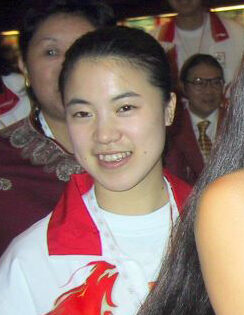
Wang Nan
Wang Nan is a Chinese table tennis player. Born October 23, 1978, in Fushun. Awards include ITTF Hall of Fame.
Facts
7 facts · 1 confirmed by two sources · 1 cited · 5 from one source
Where this comes from
Papalocal keeps its own record. It started from these sources; what each one said is kept here as it was copied, so a change on their side never changes this page by itself. Tap one to read its version.
What Wikidata says · copied November 17, 2026 · revision 2554010473
- Described as
- Chinese table tennis player (1978-)
- Born
- October 23, 1978
- Born in
- Fushun
- Citizen of
- People's Republic of China
- Occupation
- table tennis player · 1 reference
- Sport
- table tennis
- Awards
- ITTF Hall of Fame (2003)
- Height
- 1.66 m (5 ft 5 in) · 1 reference
- Wikipedias with a page
- 25
Wikidata item Q230693 (wikidata.org/wiki/Q230693), public domain (CC0). Copied November 17, 2026.
What Wikipedia says · copied November 17, 2026 · revision 1373573667
Wang Nan (Chinese: 王楠; pinyin: Wáng Nán; born October 23, 1978, in Fushun, Liaoning) is a female Chinese table tennis player from Liaoning. Wang was ranked world #1 on the ITTF ranking system from January 1999 to November 2002. She is left-handed, and began playing table tennis when she was seven years old. Her particular skills are changing the placement of the ball during rallies and her loop drive, as well as her notable speed. Wang has been the leader of the women's table-tennis team of China after Deng Yaping's retirement. In terms of achievements, she is one of the most successful female table tennis players (alongside Li Xiaoxia, Deng Yaping, Ding Ning, Zhang Yining) having won the gold medal in each of the Table Tennis World Cup, the Table Tennis World Championships, and the Olympic Games.
- Born, in its opening lines
- October 23, 1978
From the Wikipedia article “Wang Nan (table tennis)” (en.wikipedia.org/wiki/Wang_Nan_(table_tennis)), by its contributors, under CC BY-SA 4.0 (creativecommons.org/licenses/by-sa/4.0/). Copied November 17, 2026; not changed.
Confirmed Two sources agree. Cited One source, and it names where it got it. One source One source, without a reference of its own. Sources disagree The sources disagree. We show the best-supported value and keep theirs below.
