
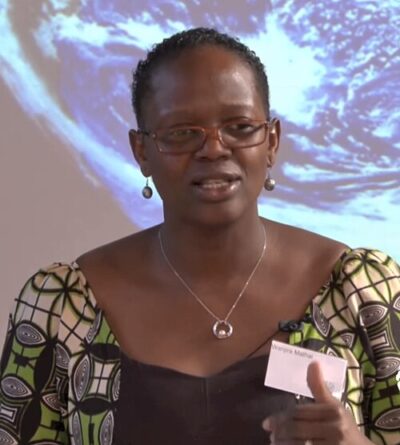
Wanjira Mathai
Wanjira Mathai is a Kenyan environmentalist. Born December 1971, in Kenya. Educated at Hobart and William Smith Colleges and Rollins School of Public Health. Awards include BBC 100 Women.
Facts
13 facts · 1 confirmed by two sources · 2 cited · 10 from one source
Where this comes from
Papalocal keeps its own record. It started from these sources; what each one said is kept here as it was copied, so a change on their side never changes this page by itself. Tap one to read its version.
What Wikidata says · copied November 17, 2026 · revision 2540950078
- Described as
- Kenyan environmentalist
- Born
- December 1971
- Born in
- Kenya · 1 reference
- Citizen of
- Kenya · 1 reference
- Occupation
- environmentalist
- Worked for
- World Resources Institute; Carter Center
- Education
- Hobart and William Smith Colleges; Rollins School of Public Health; Emory University; State House Girls High School
- Awards
- BBC 100 Women (2023) · 1 reference
- Mother
- Wangari Muta Maathai
- Website
- https://wangarimaathai.org/
- Wikipedias with a page
- 25
Wikidata item Q79996197 (wikidata.org/wiki/Q79996197), public domain (CC0). Copied November 17, 2026.
What Wikipedia says · copied November 17, 2026 · revision 1377880192
Wanjira Mathai (born December 1971) is a Kenyan environmentalist and activist. She is Managing Director for Africa and Global Partnerships at the World Resources Institute, based in Nairobi, Kenya. In this role, she takes on global issues including deforestation and energy access. She was selected as one of the 100 Most Influential Africans by New African magazine in 2018 for her role serving as the senior advisor at the World Resources Institute, as well as for her campaign to plant more than 30 million trees through her work at the Green Belt Movement.
- Born, in its opening lines
- December 1971
From the Wikipedia article “Wanjira Mathai” (en.wikipedia.org/wiki/Wanjira_Mathai), by its contributors, under CC BY-SA 4.0 (creativecommons.org/licenses/by-sa/4.0/). Copied November 17, 2026; not changed.
Confirmed Two sources agree. Cited One source, and it names where it got it. One source One source, without a reference of its own. Sources disagree The sources disagree. We show the best-supported value and keep theirs below.
