
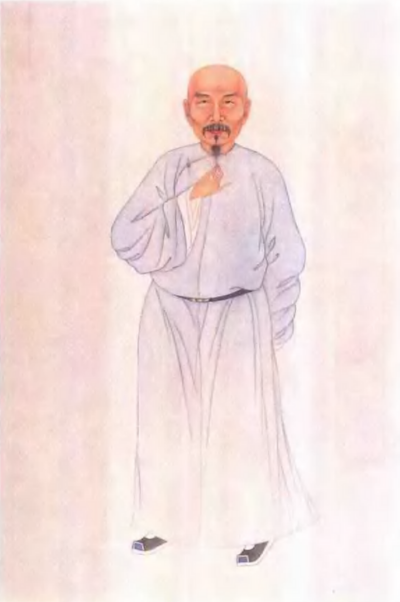
Wei Yuan
Wei Yuan was a Qing dynasty Chinese scholar. Born April 23, 1794, in Shaoyang. Died March 26, 1857, in Hangzhou. Known for Illustrated Treatise on the Maritime Kingdoms.
Facts
11 facts · 2 confirmed by two sources · 2 cited · 7 from one source
What’s different
- Died: we show March 26, 1857 (Confirmed). Wikidata also lists 1856
Where this comes from
Papalocal keeps its own record. It started from these sources; what each one said is kept here as it was copied, so a change on their side never changes this page by itself. Tap one to read its version.
What Wikidata says · copied November 18, 2026 · revision 2558955484
- Described as
- Qing dynasty Chinese scholar (1794-1857)
- Other names
- Wei Yuanda, Moshen, Hanshi, Chengguan, Guweitang, Qingyezhai, Xieyuan, Hansheng, Yunfeige, Shenweitang, Mosheng, Yinxinshi
- Born
- April 23, 1794 · 1 reference
- Died
- March 26, 1857 · 1 reference; 1856 · 1 reference
- Born in
- Shaoyang
- Died in
- Hangzhou
- Citizen of
- Qing dynasty · 1 reference
- Occupation
- philosopher; writer · 1 reference; historian; beamter · 1 reference
- Known for
- Illustrated Treatise on the Maritime Kingdoms
- Religion
- Confucianism
- Wikipedias with a page
- 20
Wikidata item Q597003 (wikidata.org/wiki/Q597003), public domain (CC0). Copied November 18, 2026.
What Wikipedia says · copied November 18, 2026 · revision 1384144460
Wei Yuan (Chinese: 魏源; pinyin: Wèi Yuán; April 23, 1794 – March 26, 1857), born Wei Yuanda (魏遠達), courtesy names Moshen (默深) and Hanshi (漢士), art name Liangtu (良圖), was a Chinese scholar-official, historian, geographer, and a major reformist thinker of the late Qing Dynasty of China. Born in Shaoyang, Hunan, he lived during the reigns of the Qianlong, Jiaqing, Daoguang, and Xianfeng emperors, and he is widely known as one of the first Qing scholar-officials to advocate for the reformation of the Qing military and government, and for the adaptation of western policies following the Qing's defeat in the First Opium War. Wei viewed the war as a signal that the Qing was significantly underdeveloped in comparison to western powers, prompting his advocacy for innovation and learning from the west to allow the Qing to catch up to the west technologically and militarily.
Wei was born in 1794 in Shaoyang, Hunan. Having passed the provincial imperial examination in 1822 and officially becoming a Qing statesman in 1825, this meant Wei first became a Qing official before he began his philosophical work in 1826. Notwithstanding this however, Wei actually compiled most of his work regarding such advocacies regarding western learning after moving to Yangzhou, Jiangsu in 1831, where he remained for the rest of his life. Posterior to the First Opium War, Wei worked closely with political philosopher Lin Zexu and Mongol nobleman Qishan, both of which had first-hand experience in the war. Wei was deeply concerned with the crisis facing China in the early 19th century, and while he remained loyal to the Qing dynasty, he also sketched a number of proposals for the improvement of the administration of the empire.
His philosophical works served as an integral part of the foundation of the self-strengthening movement, a major reformist movement in the late 1800s to incorporate western technology into the Qing Dynasty, which occurred promptly after his death in 1857. . His enduring legacy is anchored in his role as a pioneering pioneer of modern Chinese reform, advocating for the Qing to "open its eyes to the world" to understand and counter Western imperialism.
- Born, in its opening lines
- April 23, 1794
- Died, in its opening lines
- March 26, 1857
From the Wikipedia article “Wei Yuan” (en.wikipedia.org/wiki/Wei_Yuan), by its contributors, under CC BY-SA 4.0 (creativecommons.org/licenses/by-sa/4.0/). Copied November 18, 2026; not changed.
Confirmed Two sources agree. Cited One source, and it names where it got it. One source One source, without a reference of its own. Sources disagree The sources disagree. We show the best-supported value and keep theirs below.
