
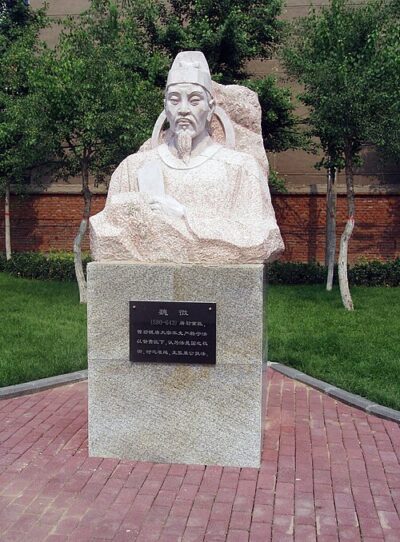
Wei Zheng
Wei Zheng was a Tang Dynasty chancellor. Born 580, in Julu County. Died 643, in Chang'an, Tang Empire. Positions held include Chancellor of the Tang dynasty. Known for Book of Sui.
Facts
19 facts · 2 confirmed by two sources · 7 cited · 10 from one source
Where this comes from
Papalocal keeps its own record. It started from these sources; what each one said is kept here as it was copied, so a change on their side never changes this page by itself. Tap one to read its version.
What Wikidata says · copied November 17, 2026 · revision 2552869629
- Described as
- Tang Dynasty chancellor (580-643)
- Other names
- Wei Zhi, Wei zhenggong, Wenzhen, Xuancheng, Duke Wenzhen of Zheng
- Born
- 580 · 4 references
- Died
- 643 · 4 references
- Born in
- Julu County
- Died in
- Chang'an, Tang Empire
- Citizen of
- Tang dynasty (618–) · 1 reference; Northern Zhou (–581); Sui dynasty (581–618)
- Occupation
- politician; poet; philosopher · 1 reference; historian · 2 references
- Positions held
- Chancellor of the Tang dynasty
- Known for
- Book of Sui
- Children
- Wei Shuyu · 1 reference; Wei Shuwan · 1 reference; Wei Shulin · 1 reference; Wei Shuyu · 1 reference; Wei Shusheng · 1 reference
- Father
- Wei Changxian · 1 reference
- Wikipedias with a page
- 26
Wikidata item Q378356 (wikidata.org/wiki/Q378356), public domain (CC0). Copied November 17, 2026.
What Wikipedia says · copied November 17, 2026 · revision 1384602491
Wei Zheng (580 – 11 February 643), courtesy name Xuancheng, posthumous name Wenzhen, was a Chinese politician and historian. He served as a chancellor of the Tang dynasty for about 13 years during the reign of Emperor Taizong. He was also the lead editor of the official history of the Sui dynasty, the Book of Sui, which was composed in 636.
Wei Zheng was born to a poor family in modern Hebei, and joined Li Mi's rebellion against the Sui dynasty in his youth. After Li Mi's submission to the Tang Empire, Wei Zheng became a Tang official and eventually served on the staff of Li Jiancheng, the Crown Prince and eldest son of Emperor Gaozu, the Tang dynasty's founding emperor. As such, he served against the interests of Li Jiancheng's younger brother, Li Shimin (the Prince of Qin), with whom Li Jiancheng was locked in an intense rivalry. In 626, Li Shimin ambushed and killed Li Jiancheng, and then effectively forced Emperor Gaozu to yield the throne to him.
Rather than punishing Wei Zheng, however, he was impressed with Wei's faithfulness to Li Jiancheng, and he made Wei an important official, eventually a chancellor. Wei Zheng's promotion to this position gave him far broader freedom to criticise others, particularly the emperor, than other officers of the court. He emphasized propriety and opposed overextending the state. His advice and criticism were not always accepted, but in accordance with Confucian etiquette, the emperor would concede to his suggestions with some regularity.
After Wei Zheng's death in 643, the emperor commented that he was a mirror to show the mistakes of the court, and built an elaborate tomb for him near his own imperial tomb and betrothed one of his daughters, Princess Hengshan, to Wei Shuyu (魏叔玉), Wei Zheng's son. Subsequently, as a result of false accusations made by others in the court, the stone monument that Emperor Taizong had built for Wei Zheng was destroyed, and Emperor Taizong cancelled the planned marriage between Princess Hengshan and Wei Shuyu. However, after the failure of the campaign against Goguryeo in 646, Emperor Taizong, believing that Wei Zheng would have stopped him from going on the campaign had he lived longer, restored the stone monument. Wei Zheng's effect and influence has been examined by many historians long after his death. Wei Zheng is also revered as a minor god of doorways in parts of Taiwan.
- Born, in its opening lines
- 580
- Died, in its opening lines
- February 11, 643
From the Wikipedia article “Wei Zheng” (en.wikipedia.org/wiki/Wei_Zheng), by its contributors, under CC BY-SA 4.0 (creativecommons.org/licenses/by-sa/4.0/). Copied November 17, 2026; not changed.
Confirmed Two sources agree. Cited One source, and it names where it got it. One source One source, without a reference of its own. Sources disagree The sources disagree. We show the best-supported value and keep theirs below.
