
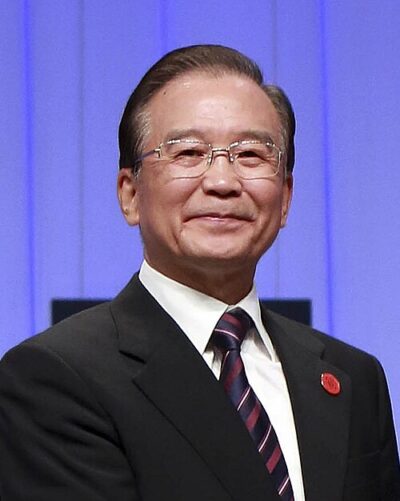
Wen Jiabao
Wen Jiabao is the 6th Premier of the People's Republic of China from 2003 to 2013. Born September 15, 1942, in Tianjin. Positions held include Vice Premier of the State Council of the People's Republic of China (1998–2003), Premier of the People's Republic of China (2003–2013) and member of the Politburo of the Chinese Communist Party (1997–2012). Educated at Tianjin Nankai High School and China University of Geosciences.

Facts
22 facts · 1 confirmed by two sources · 4 cited · 17 from one source
Where this comes from
Papalocal keeps its own record. It started from these sources; what each one said is kept here as it was copied, so a change on their side never changes this page by itself. Tap one to read its version.
What Wikidata says · copied November 16, 2026 · revision 2562715703
- Described as
- 6th Premier of the People's Republic of China from 2003 to 2013 (born 1942)
- Other names
- Jiabao Wen, 温家宝总理
- Born
- September 15, 1942 · 4 references
- Born in
- Tianjin · 1 reference
- Name at birth
- 溫家寶 · 1 reference
- Citizen of
- People's Republic of China
- Occupation
- politician · 1 reference; geologist; economist; engineer · 1 reference
- Positions held
- Vice Premier of the State Council of the People's Republic of China (1998–2003); Premier of the People's Republic of China (2003–2013); member of the Politburo of the Chinese Communist Party (1997–2012); Director of the General Office of the Chinese Communist Party (1986–1993); member of the Politburo Standing Committee of the Chinese Communist Party (2002–2012)
- Political party
- Chinese Communist Party (1965–)
- Education
- Tianjin Nankai High School; China University of Geosciences
- Member of
- Politburo Standing Committee of the Chinese Communist Party (2002–2012)
- Spouse
- Zhang Peili
- Children
- Wen Yunsong; Wen Ruchun
- Mother
- Yang Zhiyun · 1 reference
- Religion
- atheism
- Wikipedias with a page
- 86
Wikidata item Q16628 (wikidata.org/wiki/Q16628), public domain (CC0). Copied November 16, 2026.
What Wikipedia says · copied November 16, 2026 · revision 1385271769
Wen Jiabao (Chinese: 温家宝; pinyin: Wēn Jiābǎo; born 15 September 1942) is a retired Chinese politician and geologist who served as the Premier of China from 2003 to 2013 and the third-ranking member of the Politburo Standing Committee of the Chinese Communist Party from 2002 to 2012.
Born in Tianjin, Wen joined the Chinese Communist Party in 1965. After graduating from university, he began his career at Gansu Geological Bureau. He rose through the ranks and in 1983 became the Vice Minister of Geology and Mineral Resources. In 1985, he was promoted to the Politburo by CCP General Secretary Hu Yaobang. Wen worked as the Director of the General Office of the Chinese Communist Party between 1986 and 1993, and accompanied Zhao Ziyang to Tiananmen Square during the 1989 protests as his secretary. In 1998, Wen was promoted to the post of Vice Premier under his mentor Zhu Rongji. As Vice Premier, he oversaw agricultural, financial and environmental policies.
In November 2002, Wen jointed the Politburo Standing Committee, becoming its third-ranking member behind CCP General Secretary Hu Jintao and National People's Congress Standing Committee Chairman Wu Bangguo. Appointed as Premier in March 2003, he sought to shift China’s economic priorities away from coastal, export-driven growth and toward reducing the burdens on farmers and migrant workers through measures such as abolishing agricultural taxes and increasing infrastructure spending. Regarded as a leading figure in the Party’s reformist wing, he expressed support for political reform. However, a 2012 New York Times exposé of his family wealth cast a shadow over his legacy. He left office in 2013 and was succeeded by Li Keqiang.
- Born, in its opening lines
- September 15, 1942
From the Wikipedia article “Wen Jiabao” (en.wikipedia.org/wiki/Wen_Jiabao), by its contributors, under CC BY-SA 4.0 (creativecommons.org/licenses/by-sa/4.0/). Copied November 16, 2026; not changed.
Confirmed Two sources agree. Cited One source, and it names where it got it. One source One source, without a reference of its own. Sources disagree The sources disagree. We show the best-supported value and keep theirs below.
