
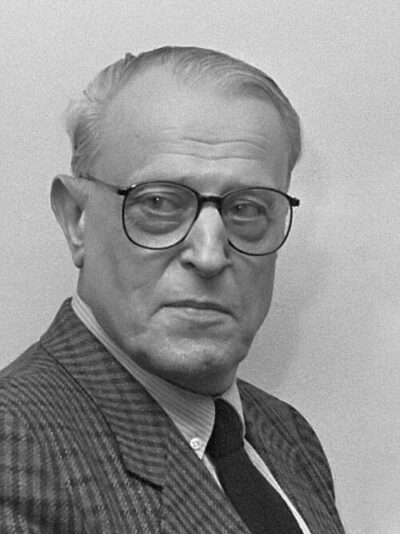
Willem Frederik Hermans
Willem Frederik Hermans was a Dutch writer. Born September 1, 1921, in Amsterdam. Died April 27, 1995, in Utrecht. Known for The Darkroom of Damocles, Beyond Sleep and Een heilige van de horlogerie. Educated at University of Amsterdam and Barlaeus Gymnasium. Awards include P.C. Hooft Award, Dutch Literature Prize and Ferdinand Bordewijk Prize.
Facts
27 facts · 2 confirmed by two sources · 13 cited · 12 from one source
Where this comes from
Papalocal keeps its own record. It started from these sources; what each one said is kept here as it was copied, so a change on their side never changes this page by itself. Tap one to read its version.
What Wikidata says · copied November 16, 2026 · revision 2570356564
- Described as
- Dutch writer (1921–1995)
- Other names
- W.F. Hermans
- Born
- September 1, 1921 · 12 references
- Died
- April 27, 1995 · 11 references
- Born in
- Amsterdam · 2 references
- Died in
- Utrecht · 1 reference
- Citizen of
- Kingdom of the Netherlands · 1 reference
- Occupation
- writer · 1 reference; translator; photographer · 2 references; university teacher · 1 reference; screenwriter; geographer · 1 reference; graphic designer · 1 reference; watercolorist · 1 reference
- Worked for
- University of Groningen
- Education
- University of Amsterdam; Barlaeus Gymnasium
- Known for
- The Darkroom of Damocles; Beyond Sleep; Een heilige van de horlogerie · 1 reference
- Awards
- P.C. Hooft Award (1971) · 1 reference; Dutch Literature Prize (1977) · 1 reference; Ferdinand Bordewijk Prize (1966) · 1 reference; Prijs van de Stichting Kunstenaarsverzet (1957); Busken Huet award (1949); Essayprijs van de gemeente Amsterdam (1949); honorary doctor of the University of Pretoria (1990); Honorary doctor of the University of Liège (1990)
- Wikipedias with a page
- 34
Wikidata item Q437771 (wikidata.org/wiki/Q437771), public domain (CC0). Copied November 16, 2026.
What Wikipedia says · copied November 16, 2026 · revision 1371739242
Willem Frederik Hermans (Dutch pronunciation: [ˈʋɪləɱ ˈfreːdərɪk ˈɦɛrmɑns]; 1 September 1921 – 27 April 1995) was a Dutch author of poetry, novels, short stories, plays, as well as book-length studies, essays, and literary criticism. His most famous works are The House of Refuge (novella, 1952), The Darkroom of Damocles (novel, 1958), and Beyond Sleep (novel, 1966).
After World War II, Hermans tried to live off his writing exclusively, but as his country was recovering from the Occupation, he had no opportunity to sustain himself. He published three collections of short stories from 1948 to 1957, chief among them the novella The House of Refuge (1952), and in 1958 became lecturer in physical geography at Groningen University, a position he retained until his move to Paris, France, in 1973. The same year 1958 he broke to a wide audience with The Darkroom of Damocles.
In the 1970s, Hermans played an important role in the unmasking of Friedrich Weinreb as a cheater of Jews in the war. Hermans refused to accept the P. C. Hooft Award for 1971. In 1977, he received the Prijs der Nederlandse Letteren, the most prestigious literary award available for writers in the language, handed out every three years alternately by the reigning Dutch and Belgian monarchs to a writer of the other country, the Belgian king Boudewijn handing the prize to Hermans. Hermans is considered one of De Grote Drie, the three most important authors in the Netherlands in the postwar period, along with Harry Mulisch and Gerard Reve.
- Born, in its opening lines
- September 1, 1921
- Died, in its opening lines
- April 27, 1995
From the Wikipedia article “Willem Frederik Hermans” (en.wikipedia.org/wiki/Willem_Frederik_Hermans), by its contributors, under CC BY-SA 4.0 (creativecommons.org/licenses/by-sa/4.0/). Copied November 16, 2026; not changed.
Confirmed Two sources agree. Cited One source, and it names where it got it. One source One source, without a reference of its own. Sources disagree The sources disagree. We show the best-supported value and keep theirs below.
