
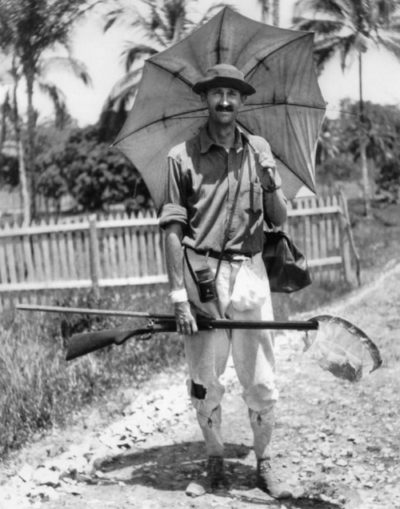
William Beebe
William Beebe was an American naturalist and explorer. Born July 29, 1877, in New York City. Died June 4, 1962, in Arima. Awards include John Burroughs Medal and Daniel Giraud Elliot Medal.
Facts
22 facts · 2 confirmed by two sources · 6 cited · 14 from one source
Where this comes from
Papalocal keeps its own record. It started from these sources; what each one said is kept here as it was copied, so a change on their side never changes this page by itself. Tap one to read its version.
What Wikidata says · copied November 15, 2026 · revision 2561414687
- Described as
- American naturalist and explorer (1877–1962)
- Other names
- C. William Beebe, Charles William Beebe, Will Beebe
- Born
- July 29, 1877 · 7 references
- Died
- June 4, 1962 · 8 references
- Born in
- New York City · 2 references
- Died in
- Arima
- Buried in
- Woodbrook Cemetery · 1 reference
- Name at birth
- Charles William Beebe
- Citizen of
- United States
- Occupation
- explorer; ornithologist; zoologist · 1 reference; entomologist; marine biologist; curator; ecologist; ichthyologist
- Member of
- American Academy of Arts and Letters
- Awards
- John Burroughs Medal (1926); Daniel Giraud Elliot Medal (1918) · 1 reference
- Field
- literature · 1 reference
- Spouse
- Blair Niles; Elswyth Thane
- Mother
- Henrietta Marie Beebe · 1 reference
- Wikipedias with a page
- 30
Wikidata item Q956868 (wikidata.org/wiki/Q956868), public domain (CC0). Copied November 15, 2026.
What Wikipedia says · copied November 15, 2026 · revision 1372011528
Charles William Beebe ( BEE-bee; July 29, 1877 – June 4, 1962) was an American naturalist, ornithologist, marine biologist, entomologist, explorer, and writer. He is remembered for the numerous expeditions he conducted for the New York Zoological Society, such as the Arcturus mission, his deep dives in the Bathysphere, and his prolific scientific writing for academic and popular audiences.
Born in Brooklyn, New York and raised in East Orange, New Jersey, Beebe left college before obtaining a degree to work at the then newly opened New York Zoological Park, where he was given the duty of caring for the zoo's birds. He quickly distinguished himself in his work for the zoo, first with his skill in designing habitats for its bird population, and soon also with a series of research expeditions of increasing length, including an expedition around the world to document the world's pheasants. These expeditions formed the basis for a large quantity of writing for both popular and academic audiences, including an account of his pheasant expedition titled A Monograph of the Pheasants and published in four volumes from 1918 to 1922. In recognition of the research conducted on his expeditions, he was granted honorary doctorates from Tufts and Colgate University.
During the course of his expeditions, Beebe gradually developed an interest in marine biology, ultimately leading to his 1930s dives in the Bathysphere, along with its inventor, Otis Barton, off the coast of Bermuda. This was the first time a biologist observed deep-sea animals in their native environment and set several successive records for the deepest dive ever performed by a human, the deepest of which stood until it was broken by Barton 15 years later. Following his Bathysphere dives, Beebe returned to the tropics and began to focus his study on the behavior of insects. In 1949, he founded a tropical research station in Trinidad and Tobago which he named Simla, and which remains in operation as part of the Asa Wright Nature Centre. Beebe's research at Simla continued until his death from pneumonia in 1962 at the age of 84.
William Beebe is regarded as one of the founders of the field of ecology, as well as one of the early 20th century's major advocates of conservation. He is also remembered for several theories he proposed about avian evolution which are now regarded as having been ahead of their time, particularly his 1915 hypothesis that the evolution of bird flight passed through a four-winged or "Tetrapteryx" stage, which has been supported by the 2003 discovery of Microraptor gui.
- Born, in its opening lines
- July 29, 1877
- Died, in its opening lines
- June 4, 1962
From the Wikipedia article “William Beebe” (en.wikipedia.org/wiki/William_Beebe), by its contributors, under CC BY-SA 4.0 (creativecommons.org/licenses/by-sa/4.0/). Copied November 15, 2026; not changed.
Confirmed Two sources agree. Cited One source, and it names where it got it. One source One source, without a reference of its own. Sources disagree The sources disagree. We show the best-supported value and keep theirs below.
