
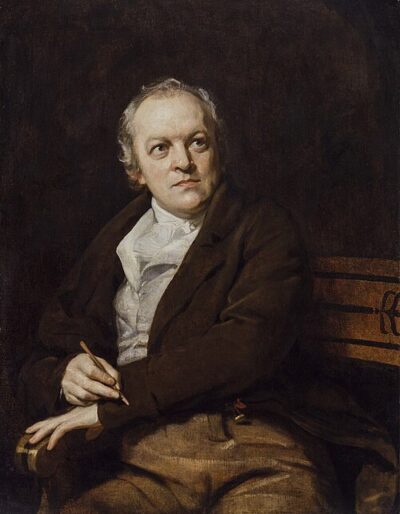
William Blake
William Blake was an English poet and artist. Born November 28, 1757, in London. Died August 12, 1827, in London. Known for The Marriage of Heaven and Hell, Jerusalem and Songs of Innocence and of Experience. Educated at Royal Academy of Arts and Henry Pars Drawing School.
Facts
46 facts · 2 confirmed by two sources · 27 cited · 17 from one source
Where this comes from
Papalocal keeps its own record. It started from these sources; what each one said is kept here as it was copied, so a change on their side never changes this page by itself. Tap one to read its version.
What Wikidata says · copied November 16, 2026 · revision 2558282023
- Described as
- English poet and artist (1757–1827)
- Other names
- W. Blake, Blake, Uil'iam Bleik
- Born
- November 28, 1757 · 21 references
- Died
- August 12, 1827 · 20 references
- Born in
- London · 4 references
- Died in
- London · 3 references
- Buried in
- Bunhill Fields · 2 references
- Citizen of
- United Kingdom of Great Britain and Ireland; Kingdom of Great Britain (–1801); United Kingdom · 1 reference
- Occupation
- painter · 5 references; poet · 3 references; theologian; collector · 1 reference; printmaker · 4 references; illustrator · 3 references; philosopher · 1 reference; lithographer · 1 reference
- Education
- Royal Academy of Arts (1779–) · 1 reference; Henry Pars Drawing School (1767–) · 1 reference
- Member of
- The New Church · 1 reference
- Genre
- history painting · 1 reference; religious painting · 1 reference; allegory · 1 reference; religious art · 1 reference; mythological painting · 1 reference; allegory · 1 reference
- Known for
- The Marriage of Heaven and Hell; Jerusalem; Songs of Innocence and of Experience; Vala, or The Four Zoas; Jerusalem The Emanation of the Giant Albion; Milton; The Ancient of Days
- Field
- poetry · 1 reference
- Spouse
- Catherine Blake (1782–) · 2 references
- Father
- James Blake · 1 reference
- Mother
- Catherine Hermitage · 1 reference
- Siblings
- Robert Blake · 1 reference; James Blake · 1 reference; John Blake · 1 reference; Jimmy Solís Delgado; Catherine Elizabeth Blake · 1 reference
- Lived in
- Green Street (1782–1784) · 1 reference; Broadwick Street (3 times) (1757–1803) · 2 references; Poland Street (1785–1791) · 2 references; Hercules Buildings (1791–) · 2 references; Felpham (1800–1803) · 1 reference
- Wikipedias with a page
- 162
Wikidata item Q41513 (wikidata.org/wiki/Q41513), public domain (CC0). Copied November 16, 2026.
What Wikipedia says · copied November 16, 2026 · revision 1384867776
William Blake (28 November 1757 – 12 August 1827) was an English poet, painter and printmaker. Largely unrecognised during his life, Blake has become a seminal figure in the history of the poetry and visual art of the Romantic Age. What he called his "prophetic works" were said by the 20th-century critic Northrop Frye to form "what is in proportion to its merits the least read body of poetry in the [English] language". While he lived in London his entire life, except for three years spent in Felpham, he produced a diverse and symbolically rich collection of works, which embraced the imagination as "the body of God", or "human existence itself".
Although Blake was considered mad by contemporaries for his idiosyncratic views, he came to be highly regarded by later critics and readers for his expressiveness and creativity, and for the philosophical and mystical undercurrents within his work. His paintings and poetry have been characterised as part of the Romantic movement and as "Pre-Romantic". He was hostile to the Church of England (indeed, to almost all forms of organised religion), and was influenced by the ideals and ambitions of the French and American Revolutions. Although later he rejected many of these political beliefs, he maintained an amicable relationship with the political activist Thomas Paine; he was also influenced by thinkers such as Emanuel Swedenborg. Despite these known influences, the singularity of Blake's work makes him difficult to classify. The 19th-century scholar William Michael Rossetti characterised him as a "glorious luminary", and "a man not forestalled by predecessors, nor to be classed with contemporaries, nor to be replaced by known or readily surmisable successors".
Collaboration with his wife, Catherine Boucher, was instrumental in the creation of many of his books. Boucher worked as a printmaker and colourist for his works. "For almost forty-five years she was the person who lived and worked most closely with Blake, enabling him to realize numerous projects, impossible without her assistance. Catherine was an artist and printer in her own right," writes the literary scholar Angus Whitehead.
- Born, in its opening lines
- November 28, 1757
- Died, in its opening lines
- August 12, 1827
From the Wikipedia article “William Blake” (en.wikipedia.org/wiki/William_Blake), by its contributors, under CC BY-SA 4.0 (creativecommons.org/licenses/by-sa/4.0/). Copied November 16, 2026; not changed.
Confirmed Two sources agree. Cited One source, and it names where it got it. One source One source, without a reference of its own. Sources disagree The sources disagree. We show the best-supported value and keep theirs below.
