
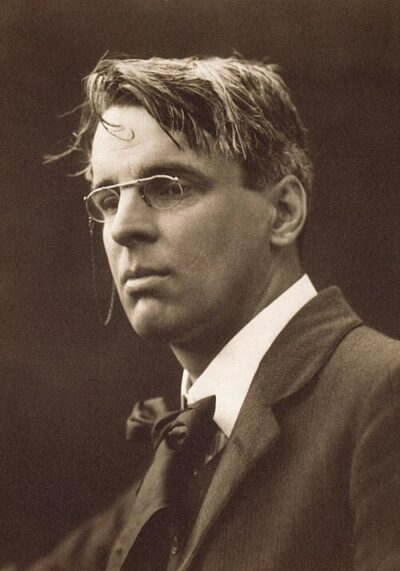
William Butler Yeats
William Butler Yeats was an Irish poet and playwright. Born June 13, 1865, in Sandymount. Died January 28, 1939, in Menton. Positions held include senator of Ireland (1922–1928). Educated at National College of Art and Design and The High School, Dublin. Awards include Nobel Prize in Literature, Goethe Plaque of the City of Frankfurt and Fellow of the Royal Society of Literature.
Facts
35 facts · 2 confirmed by two sources · 21 cited · 11 from one source · 1 where the sources disagree
What’s different
- Died in: we show Menton (Sources disagree). Wikidata also lists Roquebrune-Cap-Martin
Where this comes from
Papalocal keeps its own record. It started from these sources; what each one said is kept here as it was copied, so a change on their side never changes this page by itself. Tap one to read its version.
What Wikidata says · copied November 16, 2026 · revision 2567488758
- Described as
- Irish poet and playwright (1865–1939)
- Other names
- WBY, W. B. Yeats, William Yeats, W.B. Yeats, Yeats
- Born
- June 13, 1865 · 16 references
- Died
- January 28, 1939 · 14 references
- Born in
- Sandymount · 2 references
- Died in
- Menton · 1 reference; Roquebrune-Cap-Martin · 1 reference
- Buried in
- Drumcliff · 1 reference
- Citizen of
- Irish Free State · 1 reference
- Occupation
- poet · 5 references; playwright · 3 references; writer · 5 references; politician; mystic; astrologer
- Positions held
- senator of Ireland (1922–1928) · 1 reference
- Education
- National College of Art and Design; The High School, Dublin
- Member of
- Hermetic Order of the Golden Dawn; Royal Society of Literature; Yeats family
- Awards
- Nobel Prize in Literature (1923) · 2 references; Goethe Plaque of the City of Frankfurt (1934) · 1 reference; Fellow of the Royal Society of Literature; Doctor of Letters
- Field
- fiction · 1 reference; poetry · 1 reference; drama · 1 reference
- Spouse
- Georgie Hyde-Lees · 1 reference
- Children
- Anne Yeats · 1 reference; Michael Yeats · 1 reference
- Father
- John Butler Yeats · 1 reference
- Mother
- Susan Pollexfen · 1 reference
- Siblings
- Elizabeth Yeats · 1 reference; Lily Yeats · 1 reference; Jack Butler Yeats · 1 reference; Robert Corbet Yeats · 1 reference; Jane Grace Yeats · 1 reference
- Wikipedias with a page
- 154
Wikidata item Q40213 (wikidata.org/wiki/Q40213), public domain (CC0). Copied November 16, 2026.
What Wikipedia says · copied November 16, 2026 · revision 1385514719
William Butler Yeats ( YAYTS; 13 June 1865 – 28 January 1939) was an Irish poet, dramatist, writer and literary critic who was one of the foremost figures of 20th-century literature. He was a driving force behind the Irish Literary Revival and, along with John Millington Synge and Lady Gregory, founded the Abbey Theatre, serving as its chief during its early years. He was awarded the 1923 Nobel Prize in Literature and later served two terms as a Senator of the Irish Free State.
A Protestant of Anglo-Irish descent, Yeats was born in Sandymount, Ireland. His father practised law and was a portrait painter. He was educated in Dublin and London and spent his childhood holidays in County Sligo. He studied poetry from an early age, when he became fascinated by Irish legends and the occult. While in London he became part of the Irish literary revival. His early poetry was influenced by John Keats, William Wordsworth, William Blake and many more. These topics feature in the first phase of his work, lasting roughly from his student days at the Metropolitan School of Art in Dublin until the end of the 19th century. His earliest volume of verse was published in 1889, and its slow-paced, modernist and lyrical poems display debts to Edmund Spenser, Percy Bysshe Shelley and the poets of the Pre-Raphaelite Brotherhood.
From 1900 his poetry became more rooted in the physical world, realistic and politicised. He moved away from the transcendental beliefs of his youth, though he remained preoccupied with some elements including cyclical theories of life. He had become the chief playwright for the Irish Literary Theatre in 1897, and early on promoted younger poets such as Ezra Pound. His major works include The Land of Heart's Desire (1894), Cathleen ni Houlihan (1902), The Wild Swans at Coole (1919) and The Tower (1928).
- Born, in its opening lines
- June 13, 1865
- Died, in its opening lines
- January 28, 1939
From the Wikipedia article “W. B. Yeats” (en.wikipedia.org/wiki/W._B._Yeats), by its contributors, under CC BY-SA 4.0 (creativecommons.org/licenses/by-sa/4.0/). Copied November 16, 2026; not changed.
Confirmed Two sources agree. Cited One source, and it names where it got it. One source One source, without a reference of its own. Sources disagree The sources disagree. We show the best-supported value and keep theirs below.
