
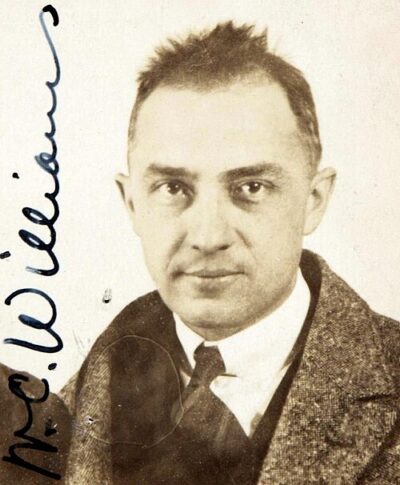
William Carlos Williams
William Carlos Williams was an American poet. Born September 17, 1883, in Rutherford. Died March 4, 1963, in Rutherford. Known for Paterson. Educated at Lycée Condorcet and Horace Mann School. Awards include Bollingen Prize, Pulitzer Prize for Poetry and National Book Award.
Facts
26 facts · 2 confirmed by two sources · 12 cited · 12 from one source
Where this comes from
Papalocal keeps its own record. It started from these sources; what each one said is kept here as it was copied, so a change on their side never changes this page by itself. Tap one to read its version.
What Wikidata says · copied November 13, 2026 · revision 2566066763
- Described as
- American poet (1883-1963)
- Born
- September 17, 1883 · 14 references
- Died
- March 4, 1963 · 14 references
- Born in
- Rutherford · 2 references
- Died in
- Rutherford · 2 references
- Buried in
- Hillside Cemetery · 1 reference
- Citizen of
- United States
- Occupation
- poet · 1 reference; physician; autobiographer; physician writer; literary critic; writer · 1 reference
- Education
- Lycée Condorcet; Horace Mann School; Perelman School of Medicine at the University of Pennsylvania · 2 references
- Member of
- American Academy of Arts and Letters
- Known for
- Paterson
- Awards
- Bollingen Prize (1953); Pulitzer Prize for Poetry (1963) · 1 reference; National Book Award (1950) · 1 reference; New Jersey Hall of Fame (2009) · 1 reference; Fellowship of the Academy of American Poets (1956) · 1 reference; Russell Loines Award for Poetry
- Field
- poetry · 1 reference; literary activity · 1 reference
- Siblings
- Edgar I. Williams · 1 reference
- Wikipedias with a page
- 65
Wikidata item Q178106 (wikidata.org/wiki/Q178106), public domain (CC0). Copied November 13, 2026.
What Wikipedia says · copied November 13, 2026 · revision 1384434886
William Carlos Williams (September 17, 1883 – March 4, 1963) was an American poet and physician closely associated with modernism and imagism. His Spring and All (1923) was written in the wake of T. S. Eliot's The Waste Land (1922). In his five-volume poem Paterson (1946–1958), he took Paterson, New Jersey as "my 'case' to work up: “It called for a poetry such as I did not know, it was my duty to discover or make such a context on the 'thought.'" Some of his best-known poems, "This Is Just to Say" and "The Red Wheelbarrow", are reflections on the everyday. Other poems reflect the influence of the visual arts. He, in turn, influenced the visual arts; his poem "The Great Figure" inspired the painting I Saw the Figure 5 in Gold by Charles Demuth. Williams was awarded a posthumous Pulitzer Prize for Poetry for Pictures from Brueghel and Other Poems (1962).
Williams practiced both pediatrics and general medicine. He was affiliated with Passaic General Hospital, where he served as the hospital's chief of pediatrics from 1924 until his death. The hospital, which is now known as St. Mary's General Hospital, paid tribute to Williams with a memorial plaque that states "We walk the wards that Williams walked".
Randall Jarrell wrote that Williams "feels, not just says, that the differences between men are less important than their similarities—that he and you and I, together, are the Little Men." Marc Hofstadter wrote that Williams "sought to express his democracy through his way of speaking. His point was to speak on an equal level with the reader and to use the language and thought materials of America in expressing his point of view." Per Hugh Fox, Williams saw "the real [original emphasis] function of the imagination as breaking through the alienation of the near at hand and reviving its wonder."
- Born, in its opening lines
- September 17, 1883
- Died, in its opening lines
- March 4, 1963
From the Wikipedia article “William Carlos Williams” (en.wikipedia.org/wiki/William_Carlos_Williams), by its contributors, under CC BY-SA 4.0 (creativecommons.org/licenses/by-sa/4.0/). Copied November 13, 2026; not changed.
Confirmed Two sources agree. Cited One source, and it names where it got it. One source One source, without a reference of its own. Sources disagree The sources disagree. We show the best-supported value and keep theirs below.
