
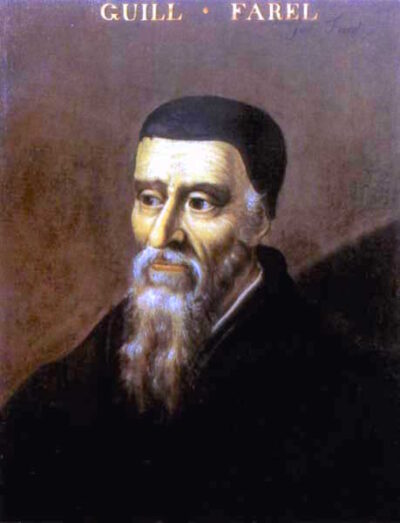
William Farel was a French evangelist. Born 1489, in Gap. Died September 13, 1565, in Neuchâtel.
Facts
11 facts · 2 confirmed by two sources · 3 cited · 6 from one source
Where this comes from
Papalocal keeps its own record. It started from these sources; what each one said is kept here as it was copied, so a change on their side never changes this page by itself. Tap one to read its version.
What Wikidata says · copied November 16, 2026 · revision 2569839641
- Described as
- French evangelist
- Other names
- Guillaume Farel, Guilhem Farel
- Born
- 1489 · 10 references
- Died
- September 13, 1565 · 4 references
- Born in
- Gap · 1 reference
- Died in
- Neuchâtel · 1 reference
- Name at birth
- Guilhem Farel
- Citizen of
- France
- Occupation
- theologian; cleric · 1 reference; teacher · 1 reference; Protestant reformer · 1 reference
- Religion
- Reformed Christianity
- Wikipedias with a page
- 31
Wikidata item Q435456 (wikidata.org/wiki/Q435456), public domain (CC0). Copied November 16, 2026.
What Wikipedia says · copied November 16, 2026 · revision 1370285599
William Farel (French: Guillaume Farel [ɡijom faʁɛl]; 1489 – 13 September 1565) was a French evangelist, Protestant reformer and a founder of the Reformed Church in French-speaking Switzerland. He is most often remembered for having persuaded John Calvin to remain in Geneva in 1536, and for persuading him to return there in 1541, after their expulsion in 1538. The Genevan Reformation was so profound that it became known as the "Protestant Rome", where Protestants took refuge and their opponents such as Catholics and unitarians were driven out. Together with Calvin, Farel worked to train missionary preachers who spread the Protestant cause to other countries, especially to France.
- Born, in its opening lines
- 1489
- Died, in its opening lines
- September 13, 1565
From the Wikipedia article “William Farel” (en.wikipedia.org/wiki/William_Farel), by its contributors, under CC BY-SA 4.0 (creativecommons.org/licenses/by-sa/4.0/). Copied November 16, 2026; not changed.
Confirmed Two sources agree. Cited One source, and it names where it got it. One source One source, without a reference of its own. Sources disagree The sources disagree. We show the best-supported value and keep theirs below.
