
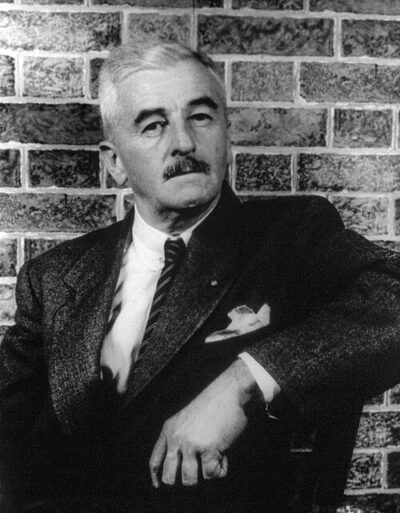
William Faulkner
William Faulkner was an American writer. Born September 25, 1897, in New Albany. Died July 6, 1962, in Byhalia. Known for The Sound and the Fury, As I Lay Dying and Light in August. Educated at University of Virginia and University of Mississippi. Awards include Nobel Prize in Literature, National Book Award (2 times) and Pulitzer Prize for Fiction (2 times).
Facts
35 facts · 2 confirmed by two sources · 11 cited · 22 from one source
Where this comes from
Papalocal keeps its own record. It started from these sources; what each one said is kept here as it was copied, so a change on their side never changes this page by itself. Tap one to read its version.
What Wikidata says · copied November 13, 2026 · revision 2565594423
- Described as
- American writer (1897-1962)
- Other names
- William Cuthbert Falkner, Faulkner, William Cuthbert Faulkner, William Falkner
- Born
- September 25, 1897 · 18 references
- Died
- July 6, 1962 · 19 references
- Born in
- New Albany · 1 reference
- Died in
- Byhalia · 1 reference
- Buried in
- Oxford Memorial Cemetery · 1 reference
- Cause of death
- myocardial infarction
- Name at birth
- William Cuthbert Falkner · 1 reference
- Citizen of
- United States
- Occupation
- screenwriter; poet; novelist; short story writer; playwright; children's writer; writer · 2 references
- Education
- University of Virginia; University of Mississippi (1919–1921)
- Member of
- American Academy of Arts and Letters
- Genre
- screenplay
- Known for
- The Sound and the Fury; As I Lay Dying; Light in August; Absalom, Absalom!; A Rose for Emily
- Awards
- Nobel Prize in Literature (1949) · 2 references; National Book Award (2 times) (1951, 1955) · 1 reference; Pulitzer Prize for Fiction (2 times) (1955, 1963) · 1 reference; Chevalier des Arts et des Lettres · 1 reference; O. Henry Award (1939); William Dean Howells Medal of the American Academy of Arts and Letters (1950)
- Field
- novel · 1 reference
- Spouse
- Estelle Oldham Faulkner (1929–1962) · 1 reference
- Father
- Murry Faulkner · 1 reference
- Siblings
- John Faulkner · 1 reference
- Religion
- Presbyterianism
- Wikipedias with a page
- 149
Wikidata item Q38392 (wikidata.org/wiki/Q38392), public domain (CC0). Copied November 13, 2026.
What Wikipedia says · copied November 13, 2026 · revision 1382397257
William Cuthbert Faulkner ( FAWK-nər; né Falkner; September 25, 1897 – July 6, 1962) was an American writer. He is best known for his novels and short stories set in the fictional Yoknapatawpha County, Mississippi, a stand-in for Lafayette County where he spent most of his life. Winner of the 1949 Nobel Prize in Literature, Faulkner is one of the most celebrated writers of American literature, often considered the greatest writer of Southern literature and one of the most influential and important writers of the 20th century.
Faulkner was born in New Albany, Mississippi, and raised in Oxford, Mississippi. During World War I, he joined the Royal Canadian Air Force, but did not serve in combat. Returning to Oxford, he attended the University of Mississippi for three semesters before dropping out. He moved to New Orleans, where he wrote his first novel Soldiers' Pay (1925). He went back to Oxford and wrote Sartoris (1927), his first work set in Yoknapatawpha County. In 1929, he published The Sound and the Fury. The following year, he wrote As I Lay Dying. Later that decade, he wrote Light in August; Absalom, Absalom!; and The Wild Palms. He also worked as a screenwriter, contributing to Howard Hawks's To Have and Have Not and The Big Sleep, adapted from Raymond Chandler's novel.
Faulkner's reputation grew following publication of Malcolm Cowley's The Portable Faulkner (1946), and he was awarded the 1949 Nobel Prize in Literature for "his powerful and unique contribution to the modern American novel." He is the only Mississippi-born Nobel laureate. Two of his works, A Fable (1954) and The Reivers (1962), won the Pulitzer Prize for Fiction. Faulkner died from a heart attack on July 6, 1962, following a fall from his horse the month before. Ralph Ellison called him "the greatest artist the South has produced".
- Born, in its opening lines
- September 25, 1897
- Died, in its opening lines
- July 6, 1962
From the Wikipedia article “William Faulkner” (en.wikipedia.org/wiki/William_Faulkner), by its contributors, under CC BY-SA 4.0 (creativecommons.org/licenses/by-sa/4.0/). Copied November 13, 2026; not changed.
Confirmed Two sources agree. Cited One source, and it names where it got it. One source One source, without a reference of its own. Sources disagree The sources disagree. We show the best-supported value and keep theirs below.
