
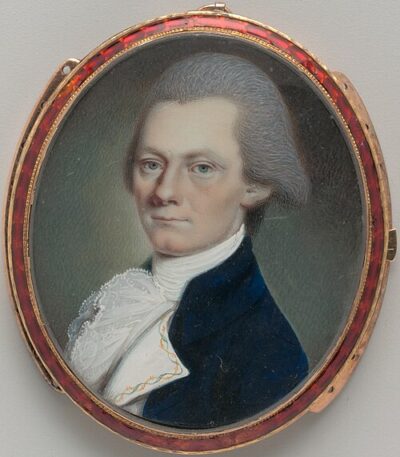
William Few
William Few was an American politician. Born June 8, 1748, in Baltimore County. Died July 16, 1828, in Beacon. Positions held include member of the Georgia House of Representatives, member of the New York State Assembly and United States senator (1789–1793).
Facts
16 facts · 2 confirmed by two sources · 2 cited · 12 from one source
Where this comes from
Papalocal keeps its own record. It started from these sources; what each one said is kept here as it was copied, so a change on their side never changes this page by itself. Tap one to read its version.
What Wikidata says · copied November 18, 2026 · revision 2517477691
- Described as
- American politician (1748-1828)
- Born
- June 8, 1748 · 1 reference
- Died
- July 16, 1828 · 1 reference
- Born in
- Baltimore County
- Died in
- Beacon
- Buried in
- New York
- Citizen of
- United States
- Occupation
- politician; lawyer; judge
- Positions held
- member of the Georgia House of Representatives; member of the New York State Assembly; United States senator (1789–1793) · 1 reference; Delegate to the United States Constitutional Convention (1787) · 1 reference
- Spouse
- Catherine Few
- Children
- Frances Few Chrystie
- Siblings
- James Few
- Wikipedias with a page
- 19
Wikidata item Q664099 (wikidata.org/wiki/Q664099), public domain (CC0). Copied November 18, 2026.
What Wikipedia says · copied November 18, 2026 · revision 1377692044
William Few. (June 8, 1748 – July 16, 1828) was an American Founding Father, lawyer, politician and jurist. He represented the U.S. state of Georgia at the Constitutional Convention and signed the U.S. Constitution. Few and James Gunn were the first U.S. Senators from Georgia.
Born into a poor yeoman farming family, Few achieved both social prominence and political power later in life. Exhibiting characteristics of self-reliance vital for survival on the American frontier, he became an intimate member of the nation's political and military elite. The idea of a frontiersman providing the democratic leaven within an association of the rich and powerful has always excited the American imagination, nurtured on stories of Davy Crockett. In the case of the self-educated Few, that image was largely accurate.
Few's inherent gifts for leadership and organization, as well as his sense of public service, were brought out by his experience in the American Revolutionary War. Important in any theater of military operations, leadership and organizational ability were particularly needed in the campaigns in south where a dangerous and protracted struggle against British forces ultimately played a crucial role in the American victory. Few's dedication to the common good and his natural military acumen quickly brought him to the attention of the leaders of the Patriot cause, who eventually invested him with important political responsibilities as well.
The war profoundly affected Few's attitude toward the political future of the new nation, transforming the rugged frontier individualist into a forceful exponent of a permanent union of the states. Men of his stripe came to realize during the years of military conflict that the rights of the individual, so jealously prized on the frontier, could be nurtured and protected only by a strong central government accountable to the people. This belief became the hallmark of his long public service.
- Born, in its opening lines
- June 8, 1748
- Died, in its opening lines
- July 16, 1828
From the Wikipedia article “William Few” (en.wikipedia.org/wiki/William_Few), by its contributors, under CC BY-SA 4.0 (creativecommons.org/licenses/by-sa/4.0/). Copied November 18, 2026; not changed.
Confirmed Two sources agree. Cited One source, and it names where it got it. One source One source, without a reference of its own. Sources disagree The sources disagree. We show the best-supported value and keep theirs below.
