
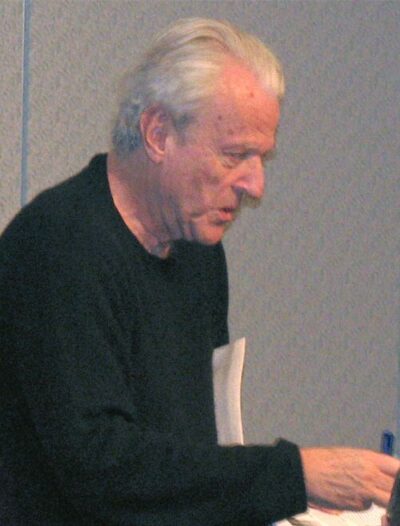
William Goldman
William Goldman was an American novelist, screenwriter and playwright. Born August 12, 1931, in Highland Park. Died November 16, 2018, in Manhattan. Known for The Princess Bride. Educated at Columbia University and Oberlin College. Awards include Writers Guild of America Award, Academy Award for Best Writing, Original Screenplay and Academy Award for Best Writing, Adapted Screenplay.
Facts
29 facts · 2 confirmed by two sources · 9 cited · 17 from one source · 1 where the sources disagree
What’s different
- Cause of death: we show colorectal cancer (Sources disagree). Wikidata also lists pneumonia
Where this comes from
Papalocal keeps its own record. It started from these sources; what each one said is kept here as it was copied, so a change on their side never changes this page by itself. Tap one to read its version.
What Wikidata says · copied November 13, 2026 · revision 2565608440
- Described as
- American novelist, screenwriter and playwright (1931-2018)
- Other names
- S. Morgenstern, Harry Longbaugh, William W. Goldman, William Weil Goldman
- Born
- August 12, 1931 · 9 references
- Died
- November 16, 2018 · 3 references
- Born in
- Highland Park
- Died in
- Manhattan
- Cause of death
- colorectal cancer; pneumonia
- Citizen of
- United States
- Occupation
- writer · 1 reference; playwright; screenwriter · 3 references; film screenwriter · 1 reference; novelist
- Education
- Columbia University; Oberlin College
- Member of
- Writers Guild of America West
- Genre
- theatre; children's literature
- Known for
- The Princess Bride
- Awards
- Writers Guild of America Award; Academy Award for Best Writing, Original Screenplay (1970) · 1 reference; Academy Award for Best Writing, Adapted Screenplay (1977) · 1 reference; Edgar Awards (1967); Hugo Award for Best Dramatic Presentation (1988)
- Field
- American literature · 1 reference; screenplay · 1 reference; creative and professional writing · 1 reference; film screenwriting · 1 reference
- Children
- Jenny Rebecca Goldman; Susanna Goldman
- Siblings
- James Goldman
- Wikipedias with a page
- 42
Wikidata item Q506885 (wikidata.org/wiki/Q506885), public domain (CC0). Copied November 13, 2026.
What Wikipedia says · copied November 13, 2026 · revision 1382105161
William Goldman (August 12, 1931 – November 16, 2018) was an American novelist, screenwriter and playwright who wrote 16 novels and numerous screenplays in a career spanning seven decades. He received the Academy Award for Best Original Screenplay and Best Screenplay from the BAFTAs and Golden Globes for his first original screenplay, Butch Cassidy and the Sundance Kid (1969), and he received the Academy Award for Best Adapted Screenplay for All the President's Men (1976). Both of these films have been inducted into the National Film Registry by the Library of Congress, along with The Princess Bride (1987) which he adapted from his 1973 novel, and all three were included on the 2006 list by the Writers Guild of America of the 101 Greatest Screenplays. Among his other accolades were three Writers Guild of America Awards, including the 1985 Laurel Award for Screenwriting Achievement, two Edgar Awards for Best Motion Picture Screenplay, and a Hugo Award for Best Dramatic Presentation.
Goldman collaborated twice each with George Roy Hill, Peter Yates, Rob Reiner and Simon West, and thrice with Richard Attenborough. He adapted his novels Marathon Man (1974, filmed in 1976), Magic (1976, filmed in 1978), and Heat (1985, filmed in 1986 and as Wild Card in 2015.) His screenplays for Misery (1990), Hearts in Atlantis (2001), and Dreamcatcher (2003) were all adapted from works by Stephen King, and he later adapted Misery for the stage in 2012. His other produced plays, Blood, Sweat and Stanley Poole (1961) and A Family Affair (1962) were collaborations with his brother James Goldman, also an Academy Award-winning writer. Goldman's other screenplays include The Stepford Wives (1975), A Bridge Too Far (1977), Chaplin (1992) and The Ghost and the Darkness (1996), and he was an uncredited script doctor on Twins (1988), A Few Good Men (1992), Indecent Proposal, Last Action Hero (both 1993), and Fierce Creatures (1997). In his later years he served as a mentor to a number of writers, including A Few Good Men writer Aaron Sorkin. His nonfiction books include The Season: A Candid Look at Broadway (1969), the memoirs Adventures in the Screen Trade (1983) and Which Lie Did I Tell? (2000), and the essay collection The Big Picture (2001).
Though Goldman was self-effacing of his own work, Sean Egan said his achievements were made "without ever lunging for the lowest common denominator. Although his body of work has been consumed by millions, he has never let his populism overwhelm a glittering intelligence and penchant for upending expectation."
- Born, in its opening lines
- August 12, 1931
- Died, in its opening lines
- November 16, 2018
From the Wikipedia article “William Goldman” (en.wikipedia.org/wiki/William_Goldman), by its contributors, under CC BY-SA 4.0 (creativecommons.org/licenses/by-sa/4.0/). Copied November 13, 2026; not changed.
Confirmed Two sources agree. Cited One source, and it names where it got it. One source One source, without a reference of its own. Sources disagree The sources disagree. We show the best-supported value and keep theirs below.
